Archive
Generations: Jesus Incarnate
Tonight’s RECTOR’s CONFERENCE was titled “Generations: Jesus Incarnate in History.” We profiled the last 5 generations with the strengths and weakenesses, along with how the Church benefits from the growth in change.
I. Prayer: Eccelesiates 3:1-8
II. Intro: (border guard story)
III. Gaudium et spec #44 (The Constitution on the Church in the Modern World, 1965):
44. Just as it is in the world’s interest to acknowledge the Church as an historical reality, and to recognize her good influence, so the Church herself knows how richly she has profited by the history and development of humanity.
The experience of past ages, the progress of the sciences, and the treasures hidden in the various forms of human culture, by all of which the nature of man himself is more clearly revealed and new roads to truth are opened, these profit the Church, too. For, from the beginning of her history she has learned to express the message of Christ with the help of the ideas and terminology of various philosophers, and and has tried to clarify it with their wisdom, too. Her purpose has been to adapt the Gospel to the grasp of all as well as to the needs of the learned, insofar as such was appropriate. Indeed this accommodated preaching of the revealed word ought to remain the law of all evangelization. For thus the ability to express Christ’s message in its own way is developed in each nation, and at the same time there is fostered a living exchange between the Church and’ the diverse cultures of people.(22) To promote such exchange, especially in our days, the Church requires the special help of those who live in the world, are versed in different institutions and specialties, and grasp their innermost significance in the eyes of both believers and unbelievers. With the help of the Holy Spirit, it is the task of the entire People of God, especially pastors and theologians, to hear, distinguish and interpret the many voices of our age, and to judge them in the light of the divine word, so that revealed truth can always be more deeply penetrated, better understood and set forth to greater advantage.
… Moreover, she gratefully understands that in her community life no less than in her individual sons, she receives a variety of helps from men of every rank and condition, for whoever promotes the human community at the family level, culturally, in its economic, social and political dimensions, both nationally and internationally, such a one, according to God’s design, is contributing greatly to the Church as well, to the extent that she depends on things outside herself. Indeed, the Church admits that she has greatly profited and still profits from the antagonism of those who oppose or who persecute her.(23)
 IV. Generations, An Intro
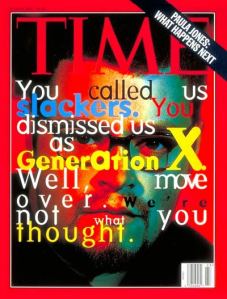
Theory of Stages of Historical Development: Crisis, High, Awakening, Unraveling
Types of Generations: Hero, Prophet, Nomad, Artist
V. General Ideas about Living Generations
The Great Generation (1911-1928) … Great Depression, World War II
The Silent Generation (1928-1942) … lived better than parents, went to college
The Baby Boomers (1942-1960) … Vietnam, civil rights, protests, assasinations, Woodstock, Watergate, Moon landing
Generation X (1961-1981) … Reagan Era, latch-key kids, no big government … smaller steps, philosophically post-modern
Millennial Generation (1982-2001) … 9/11, Internet, optimistic, “most loved generation” (Baby on Board), helicopter parents, “institution as family,” 46% non-white
VI. Considerations for Faith & Ministry
Spanish class dinner
In order to catch-up on some missing Spanish, our professor invited us to his home this evening for dinner and a study session. Our hosts were generous beyond words with a delicious steak dinner. We also brought some desert (very rich). Discussions were about everything … pet dogs … pink glass cleaner … our Easter break … Narnia (movie & book) … conditional tenses … past perfect subjunctives … que haria Jesus (WWJD) … million dollar dreams … dwarfs … poetry … and more. — a great evening.

Eucharistic music video + simplicity
I found this Eucharistic music video on You Tube. It’s a collage of pictures arranged to music by a New Age band called Era (chant of an imaginary language close to Latin). This tune is called “The Mass,” I think …
DOTS — Narnia, Lion, Witch, Wardrobe movie, part 2 (in Spanish) — dish washing duty — Rector’s Conference on “Simplicity of Life” — LOST rerun — Night Prayer 4
David Crowder Band – “O Praise Him” (song)
Since morning prayer, I’ve been singing “O praise Him, Alleluia …” and tried to find a video with it, but found another favorite by David Crowder Band called “O Praise Him” with a simple, but interesting video. Here it is:
DOTS — Narnia, Lion, Witch & Wardrobe (in Spanish) part 1 — Pauline Epistles & Theology in New Testament class — washing dishes duty — Enchanted — (Irish reporter movie?)
last mid-term day + take home exam
After our last mid-term exam, we can go “home” for one week of mid-term break. I still, however, have a take home exam for Contemporary Philosophy that’s due by email by midnight. Six short-answer essay question about Kierkegaard, Marx, Adam Smith, Catholic Social Teaching, and Nietzche. Here’s a couple answers that I’m pretty confident of.
2. (Kierkegaard) What constitutes the most significant difference between the aesthetic and ethical choice? Explain.
The most significant difference between the aesthetic and ethical choice is whether or not someone makes a true choice ‘for the self.’ The more difficult choice is the ‘ethical’ choice, since in involves choosing to be who and what one truly and uniquely is by intimately ‘knowing himself’ with a constant ‘honesty to oneself’ and minimizing the temptations of easier, more convenient decisions. This leads to an authentic existence. One the other hand, ‘aesthetic’ choice leads to an inauthentic existence of compromising true selfhood in order to settle for the convenient outside (external) creating a ‘self lost in the they’ (the crowd, the mob, the inauthentic). Aesthetic choice is lost in the forest of ‘deliberation’ because it is ultimately afraid or simply unwilling to embark on something it fears, ceaselessly jumping from one source of enjoyment to the other, hoping to postpone the inevitable call to ‘be one’s self.” It does not make a true choice ‘for the self’ and, therefore, does not know itself but only thinks it does.
3. Explain the relationship of the ‘individual good’ and the ‘common good’ from the perspective of (i) Marx, (ii) Smith, and (iii) Catholic Social Theory.
(i) Marx minimizes the ‘individual good’ and give priority to the ‘common good.’ Since the human person is a producing, creating person, the individual’s value and importance is defined by our social relations, primarily in terms of economics, politics and society. His focus on the common good encourages policy to benefit ‘everyone’ in, at least, minimal personal needs, but at the expense of the wants of individuals. In his Communist model, the guidelines evidence this emphasis. The abolition of property and inheritances strip the individual of personal power. State centralized credit, banking, transportation, communication, schooling, labor & business oversight creates a dependence by the people to a shared ‘common good,’ but minimizes the unique and personal dignity of the ‘individual good.’
(ii) Smith gives priority to the ‘individual good’ over the ‘common good.’ The individual is empowered with opportunities of self-achievement through Capitalist avenues of mostly personal financial benefit. The ‘individual good’ may compromise the ‘common good’ by gaining such personal benefits at the expense, and from the work, of the poor working class. Even though the growth of the poor affect the individual manager, the extremely disproportional results minimize the personal dignity of needs of ‘all’ individuals. Government measures need to be put in place to somewhat offset the extreme costs to the ‘common good’ for the sake of justice.
(iii) Catholic Social Teaching carefully keeps a healthy balance between ‘individual good’ and the ‘common good.” The ‘common good’ indicates the sum total of social conditions which allow people, either as groups or as individuals, to reach their fulfillment more fully and more easily. A medium of ideas should constantly be pursued so as to uphold the benefits, while working for justice to maintain the dignity of everyone ‘individual good.”
There was a challenging question about how each of our studied philosophers touch on “human transcendence,” but I wasn’t inspired enough to answer with confidence.
Leeland songs + poverty
I stumbled upon some great videos by a newer Christian group called Leeland. They’re very deep, passionate and “present.” I also saw them in concert last year at an Aquire the Fire youth conference. I fresh and renewing sound to the Christian mainstream.
The first video/song is Leeland’s “Tears of the Saints“ with a collage of today’s poverty [dedicated to Karl Marx, spokesman for the poor, & Contemporary Philosophy class]. The video (and included lyrics) was put together by a Baptist minister. There are others on YouTube, but I like this one.
The second video/song is Leeland’s “Sound of Melodies“ — simply a great sound.
This last video is Leeland in concert with a moment of Scripture & “How Great Thou Art.” — indeed.
ping pong + Jericho back
 MINISTERIAL PRACTICUM — (yesterday) Multiple choice mid-term. [aces]
NEW TESTAMENT — mid-term exam. Multiple choice.
DOTS — dinner canolli — Medieval Philosophy study group — Jericho returns (finally!)
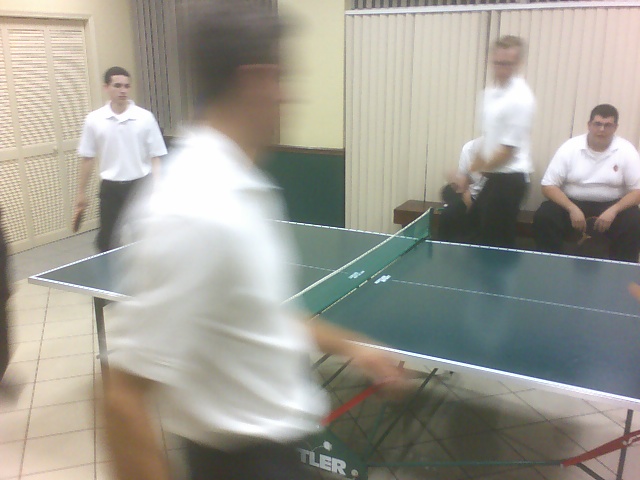
PING PONG — tonight was the last semi-final round for our Ping-Pong Olympic Tournament. Great match-up and awesome game, even with the “unruly crowd.” 🙂


soldier charity + Catholic teacher + A River Runs Through It
 MASS – (Fr Alvarez) — today is the feast day of St Jerome Emiliani. He was a soldier who left the military life to pursue great acts of charity, especially in caring for the sick in hospitals, the poor and children in orphanages. — his life resonates with me, especially with my past interest in the military (in which health concerns removed)
 FIELD TRIP — for our Ministerial Practicum class, in the afternoon, we went to a local Catholic school to observe the teaching styles and techniques in order to prepare our own lesson plans. I was in a 7th grade English class at Immaculate Conception Catholic School and, embarassingly, couldn’t answer some of the questions my self. — when do you use who or whom?
 MOVIE NIGHT — after dinner, the Humanities Department sponsored a movie night featuring A River Runs Through It with great discussion afterwards. — I didn’t get that deep into the movie, but after discussion, I have a greater appreciation for its subtle lessons and observation on life’s journey.
Luke + Acts + Filipino food
NEW TESTAMENT – (Fr Michael) — Gospel of Luke & the Acts of the Apostles. Compared parables of the synoptic Gospel books.
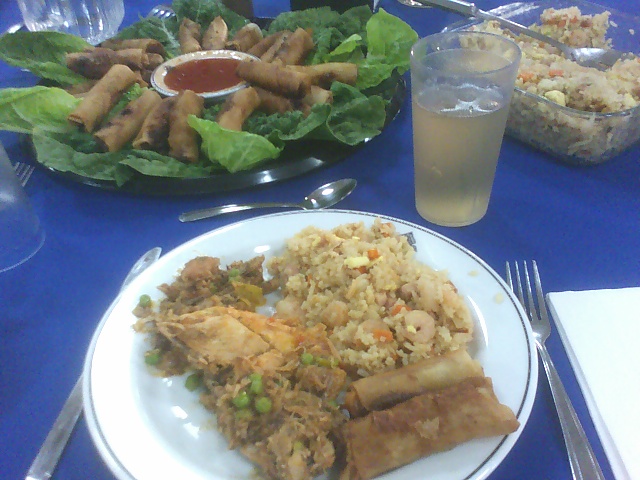
CULTURAL FOOD NIGHT — today was Filipino Food Night. Their food culture is a mix of Asian, Spanish & America. — Delicious everything … egg rolls & salsa were addictive!


lector + missing Psalm + poverty + underdog croquet
MORNING PRAYER & MASS – (Fr Vallee) — today, I was lector for the Mass reading (conversion of St Paul) and lead Liturgy of the Hours (Morning & Evening). While reading morning Laud, I TOTALLY SKIPPED the 3rd Psalm … ??? … nervous, I guess … and was reminded about it all day from my seminary brothers. — I appreciate the fraternal correction 🙂
AQUINAS – (Fr Vallee) — started Pope John Paul II’s encyclical letter Fides et Ratio. Spent some time on the opening greating:
Faith and reason are like two wings on which the human spirit rises to the contemplation of truth; and God has placed in the human heart a desire to know the truth — in a word, to know himself — so that, by knowing and loving God, men and women may also come to the fullness of truth about themselves.
 CONTEMPORARY PHIL – (Fr Santos) — started The Communist Manifesto by Karl Marx & Friedrich Engels with discussion on the “working class” and poverty. Watched an assigned video about world poverty, “When Did I See You Hungary?” a film by Gerard Thomas Straub narrated by Martin Sheen.
MEDIEVAL PHIL – (Fr Vallee) — “paradigm shift” + permanence & change + the one & the many
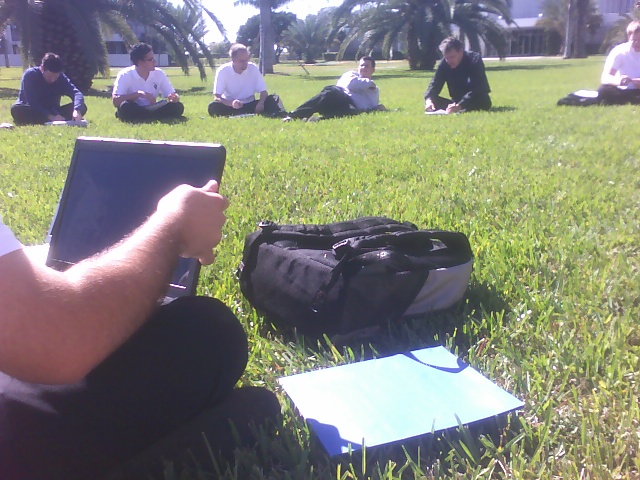
OLYMPIC CROQUET — our new sports coordinators have created an Olympic Sports Tournament over the next few weeks, including ping pong, relay races, volleyball, soccer, croquet & more. Today was our Olympic Croquet tournament, which I signed up for. 16 guys in 4-4 player games, whereby the winner of each plays for the Gold. I won my first round as an underdog in a very exciting & close game. The final round was actually ALL underdogs from the first rounds, ending with the champion being my “Guadeamus Clone” who must have copied my abilities & strategy into his collective. — A great tournament!


EVENING PRAYER & DINNER — In order to redeem myself with this morning’s blunder, my post-dinner prayer (also the lector’s job) included an “excerpt from this morning’s missing Psalm” and gratitude for food, friends, fellowship, faith & fin de semana (“weekend” in Spanish). — Dr Jimenez would be proud!
Communist Manifesto + lost weekend + homosexuality
 HOMEWORK CATCH-UP — behind on some assigned reading, I spent some of the day reading The Communist Manifesto by Karl Marx for Contemporary Philosophy class tomorrow.
PRE-THEOLOGY UPDATE — (1) the chapels in our off-campus housing should be done in about 4-6 weeks. (2) Since we raised concerns about feeling distant from the campus community, our personal “free-weekend-a-semester” opportunity has been rescinded. (3) Our house will have resident priest in a couple weeks. (4) Our backyard furniture has no status yet.
RECTOR’s CONFERENCE – (Fr Michael) — part 3 of a series on Fatherhood titled after a 2005 Vatican document, “The Instruction on the Criteria for Vocational Discernment with Regard to Persons with Homosexual Tendencies in View of Their Admission to the Seminary and Holy Orders.” [full text of document]
PRE-THE NIGHT PRAYER & ROSARY — 10pm.
INCONSISTENT SCRIPTURE — as I’m practicing tomorrow’s Mass reading (I have lector duty), there are 2 passages to choose from since it’s the feast of the Conversion of St Paul. There’s a detail in both that is inconsistent. In one reading, when Paul is blinded by the light and hears Jesus speak to him, his companions “heard the voice” of Jesus … but in the other passage, they “did not hear the voice.” I tried finding some footnotes in various Bible versions, but only found a note in the NRSV that noted the inconsistency, but didn’t give any possible explanations. — I need to look up a comentary in the library
means well + ethical hero + dualism + Taliban
MASS – (Fr Alvarez) — [an “extremely liturgically strict” priest is a poor example]
AQUINAS – (Fr Vallee) — 3 reasons for studying philosophy: (1) apologetic, (2) dogmatic, and (3) pastoral. Nemo dat quod non habet = no one gives what they don’t have. CCD teacher that only teaches emotion … 8th grader observation: “She means well, but doesn’t mean much.”
 CONTEMPORARY PHIL – (Fr Santos) — finished Kierkegaard‘s Either/Or. The “ethical existence” is choosing to be who and what one truly and uniquely is (a subject, a self, unlike any other self, unlike any other thing). Even though we have many potential directions, TO WILL EVERYTHING IS TO ULTIMATELY WILL NOTHING (one’s energy is dissipated). The self willing involves an ongoing task/process, not a finished product. Negative view of the “mystic.” The “ethical hero” is interested in becoming a “genuine human being” and “honesty to oneself” ready to give up the aesthetic if it classes with the ethical or “for the sake of” something higher. The RELIGIOUS STATE is an intensified version of the ethical, making a relationship with God the highest priority. — need to read Karl Marx Communist Manifesto for Friday.
MEDIEVAL PHIL – (Fr Vallee) — elitism (death penalty debate) + virtue (through humility) + dualism (the Forms eternal are a problem to creation) + Justin Martyr (creation, faith & reason) + Philo the Jew (the Forms are ideas in the mind of God)
WORKLIST — with the rain, the “outdoor guys” were reassigned to help other crews, which made our McCarthy House crew finish even faster.
HOLY HOUR – (Fr Alvarez) — Taliban + scandal + “be a man”
DOTS — Next
synoptics + Mark + Matthew + Columbian food + pro-life Rosary
MASS – (Fr Santos) — “the sabbath was made for man , not man for the sabbath”
SPANISH 2 – (Dr Jimenez) — chapter 15 on haber + past participles. If we stay on schedule this semester, we’ll try to read the Spanish version of The Lion, the Witch and the Wardrobe.
 NEW TESTAMENT – (Fr Michael) — today, we started the Synoptic Gospels (reviewed side-by-side syn-optically), more specifically the Gospels of Mark & Matthew. Even though Mark is the shortest gospel book, 80% of Mark’s verses are reproduced in Matthew while 65% is in Luke. There may also exist a hypothetical source “Q” that scholars propose to explain other similarities between Matthew & Luke not borrowed from Mark.
CULTURAL FOOD NIGHT — today was Columbian food night with a small army of cooks creating some great food.


PRO-LIFE ROSARY — after dinner in the McCarthy Chapel on the anniversary of Roe vs Wade for the dignity of all human persons, especially for the end to abortion.
Jewish colloquy + Nicaraguan food — “PB”
NEW TESTAMENT – (Fr Michael) — today was “colloquy“ (discussion group) about chapter 5, “The Religious & Philosophical World of New Testament Times,” of Raymond Brown‘s An Introduction to the New Testament. Much of our discussion involved the clashing views of the Jewish Sadducees, Essenes and Pharisees, but also included Greco-Roman Cynics, Epicureans, Stoicism, Sophists and Gnosticism. — stimulating
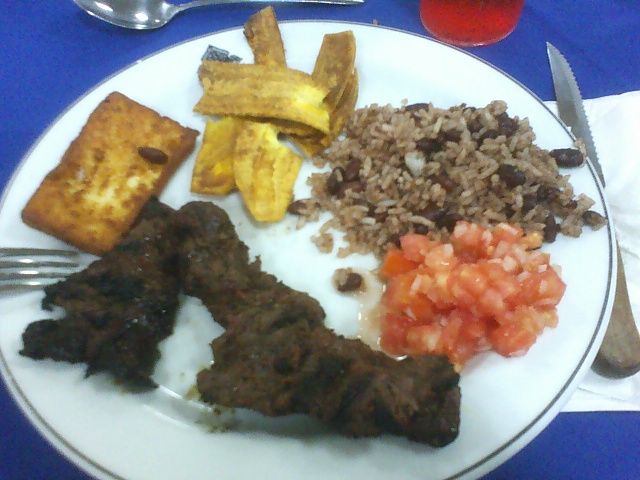 CULTURAL FOOD NIGHT — tonight was Nicaraguan Food Night. — lots of good flavors.
DOTS — starting to get sick today — found out another seminarian has discerned to leave seminary [“PB“] — extra prayers for him
beast of burden + men are right + Unknown God + body theology
 MASS – (Fr Michael) — today’s Mass intention was for Pope Benedict XVI, very appropriately with the Gospel reading of Jesus telling Peter to “Feed My Sheep.” The story behind the significance of the Corbinian Bear on the Pope’s coat of arms (upper right) was told. According to the background on Saint Corbinian (a Frankish bishop), a bear killed his pack horse on his way to Rome so the saint commanded the bear to carry his load. Pope Benedict XVI first adopted the symbol when, still known as Joseph Ratzinger, he was appointed Archbishop of Freising-Munich in March of 1977. He retained the bear in his revised coat of arms when becoming Cardinal in the same year and when elected to Pope in 2005. In addition to the obvious reference back to St. Corbinian, the founder of the diocese where Benedict was bishop, the bear represents Benedict himself being “tamed by God” as a “beast of burden” to bear the spiritual burdens of Benedict’s own ministries first as bishop, then as cardinal, and now as pope.
AQUINAS – (Fr Vallee) — more on Modernity and the extremes of Rationalism (reason) & Fideism (faith). Nature + supernature. Grace + nature. Samuel Taylor Coleridge quote: “Most men are right in what they affirm, and wrong in what they deny.”
CONTEMPORARY PHIL – (Fr Santos) — opening quiz on reading of Kierkegaard‘s “Equilibrium between the Aesthetic & the Ethical” in his book Either/Or. Introduced “inauthentic existence,” “radical subjectivity,” “disolving into a mutitude,” and self as “task” & “a dynamic process.”
 MEDIEVAL PHIL – (Fr Vallee) — reviewed Stoicism and reflected on St Paul in Athens (Acts 17), especially his approach to preaching the gospel message among the Greeks of his time about their statue to the “Unknown God.”
MINISTERIAL METHODS – (Fr Michael) — “Classroom Management.”
RECTOR’s CONFERENCE – (Fr Michael) — usually on Thursday, this was an exceptional day since this Thursday we’re hosting the seminarians from the St Vincent’s Major Seminary in Boyton Beach, FL. Today’s topic was (part 2 of 3) on the Pope John Paul II’s Theology of the Body.
DOTS — night walk — Superman Returns — busy day
perhaps + Spanish Lord’s Prayer + NT culture + Argentinian food night
 MASS – (Fr Santos) — [half sandwich Christmas gift] Jesus’ multiplication of 5 loaves & 2 fish. A supernatural miracle by Jesus … or PERHAPS a selfish crowd was moved to give from their personal stash. — Maybe? Just as fantastic of a miracle. Perhaps.
SPANISH 2 – (Dr Jimenez) — this is the second semester (the second part – I didn’t fail!) of Spanish 2. Among other things, we went over the Lord’s Prayer in Spanish (especially since the version in the Spanish Liturgy of the Hours books is completely different): [Lord’s Prayer in various languages]
Padre nuestro, que estás en el cielo
Santificado sea Tu nombre;
Venga a nosotros Tu reino.
Hágase Tu voluntad
En la tierra como en el cielo.
Danos hoy nuestro pan de cada día.
Perdona nuestras ofensas,
Como también nosotros perdonamos a los que nos ofenden.
Y no nos dejes caer en la tentación;
líbranos de todo mal.
[Porque Tuyo es el Reino, el Poder y la Gloria por siempre, Señor. Amén.]
 NEW TESTAMENT – (Fr Michael) — today, we started the semester with the Cultural Settings of the New Testament.
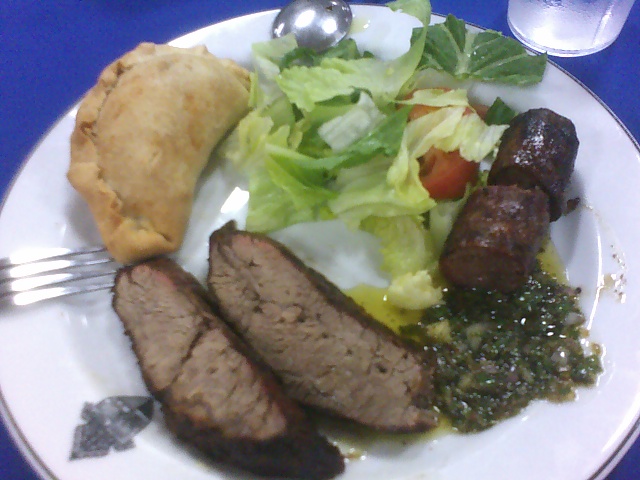
CULTURAL FOOD NIGHT — today was Argentinian Food Night for dinner. Great!
DOTS — “rejoice + divine compassion + slavery + freedom + sons of God” — watched Live Free or Die Hard
semester begins + Aquinas + Contemporary Philosophy + Medieval + Ministry + Amber Spyglass
MASS – (Fr Michael) — God is the same yesterday as today, on vacation, on retreat, back in the daily routine. Do you believe in Jesus? How is your life different because of your belief?
AQUINAS in the 20th CENTURY – (Fr Vallee) — this is a senior level course that focuses on the rediscovery of St Thomas Aquinas thought in the 19th & 20th centuries, in the areas of epistemology, metaphysics and anthropology. Readings will be from Gilson, Maritain, Marechal, Rousselot and John Paul II’s Fides et ratio. No term paper. Tests are open notes & open book — (translation: It’s hard!). Large class.
CONTEMPORARY PHILOSOPHY – (Fr Santos) — started reviewing Modern Philosophy era. LOTS of reading. Martin Buber – I and Thou … Hans-Georg Gadamer – Truth and Method … Martin Heidegger – Introduction to Metaphysics … Edmund Husserl – Phenomenology and the Crisis of Philosophy … Soren Kierkegaard – Either/Or (our first reading assignment) … Karl Marx – Communist Manifesto … Friedrich Nietzsche – The Anti-Christ … Paul Ricoeur – Oneself as Another … John Robinson – Honest to God … Adam Smith – The Wealth of Nations … Alfred North Whitehead – Religion in the Making. — I should probably be reading right now!
MEDIEVAL PHILOSOPHY – (Fr Vallee) — reviewed a timeline of philosphy periods. This class will focus on Augustine (Confessions), Anselm, and Thomas Aquinas (Summa Theologica, On Being and Essence, The Thought of Thomas Aquinas). Our main test is Frederick Copleston’s A History of Philosophy, vol II. 2 papers. — finally some Augustine & Aquinas!
MINISTERIAL PRACTICUM – (Fr Michael) — reviewed the basic about ministry (from last semester). This course will be about the practical skills need for ministry. Next year, we’ll be assigned Monday night “Apostalic Work” in the areas of CCD catechesis or Homebound Visitation. We’ll be going out to visit other seminarians in their work assignments throughout the semester. Today, we also learned “How to Create a Lesson Plan” for CCD class. — finally some hands-on!
DOTS — “Kr” Lauds blessing — listened to first half of The Amber Spyglass (His Dark Materials trilogy) on audio
practical atheism
On the first day back to seminary after a 2 week Christmas break, the Rector Fr Michael had a Rector’s Conference disguised as an “Orientation Meeting” with some great points to think about as we begin a 4 day silent retreat tonight.
Beware of “practical atheism” when we say our prayers … and don’t live them.
Christianity is a lifestyle, not just an idea. C.S. Lewis quote: “For when you get down to it, is not the popular idea of Christianity simply this: that Jesus Christ was a great moral teacher and that if only we took His advice we might be able to establish a better social order and avoid another war?” [from chapter 23 of Mere Christianity]
Pope Benedict XVI quote on priesthood:
The priest must be a believer, one who converses with God. If this is not the case, then all his activities are futile. The most lofty and important thing a priest can do for people is first of all being what he is: a believer. Through faith he lets God, the other, come into the world. And if the other is not at work, our work will never be enough; When people sense that one is there who believes, who lives with God and from God, hope becomes a reality for them as well. Through the faith of the priest, doors open up all around for people: it is really possible to believe, even today. All human believing is a believing-with, and for this reason the one who believes before us is so important. In many ways this person is more exposed in his faith than the others, since their faith depends on his and since, at any given time, he has to withstand the hard-ships of faith for them….
There is a mutual given-and-take in faith in which priests and lay people become mediators of the nearness of God for one another. The priest must also nurture the humility of such receiving in himself ….
The first “task” a priest has to do is to be a believer and to become one ever anew and ever more. Faith is never simply there automatically; it must be lived. It leads us into conversation with God which involves speaking and listening to the same degree. Faith and prayer belong together; they cannot be separated. The time spent by a priest on prayer and listening to Scripture is never time lost to pastoral care or time withheld from others. People sense whether the work and words of their pastor spring from prayer fabricated at his desk. [Cardinal Joseph Ratzinger, from A New Song for the Lord, tr. by Martha M Matesich, NY: Crossroad Publishing Co., 1996, and quoted in Magnificat for Holy Thursday, March 24, 2005.]
[Other links not mentioned today …The Nature of Priesthood (1990 speech by Cardinal Joseph Ratzinger) … Pope Benedict XVI’s Homily to Seminarians in Cologne: “If You Abide in Christ, You Will Bear Much Fruit” (August 19, 2005 World Youth Day Meeting)]
According to St John of the Cross, few will have an ecstacy prayer experience. Opening poem of his Dark Night of the Soul [insert here].
Ended with a guided meditation, “Feed my sheep.”

SJVCS Seminary Life Album

July '09 -- hospital chaplains @ IPF
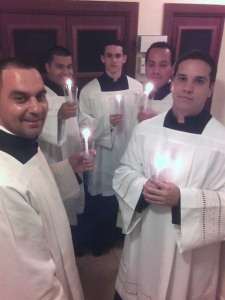
Easter '09 -- Miami SJVCS friends

the Son always finds a break in let the clouds

Feb '09 -- school vocation talks @ AMHS

Feb '09 -- cold breakfast with brothers (Matias, Fenly & Randy), now at SVDP and Imad (at SJVCS)

Superbowl '09 -- eating great @ SJVCS

Sept '08 -- Worklist Coordinators?

St Raphael Chapel mural @ SJVCS

Sept '08 -- retreats @ SJVCS

"It's not easy being green"
 Catholic Kermit
Recent Comments