Archive
Theatre + intensionality + throwness + Back Wall + social animal + simplicator + radical individualism
[here are some weak notes from last week’s Metaphysics class:]
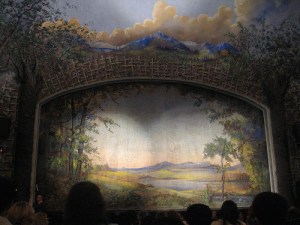 Procrastination is, therefore, the art of trying not to be human, hanging on to and not moving … repeating the same thing to the point of distracting us from thinking, avoiding “intensionality.”
———–
Man is essentially a social animal, as Aristotle said. Modernity, however, does something unique. Through Radical Individualism, the slate is wiped clean making man the only being of importance. This was best expressed by Locke … Man is essentially an individual. It is later on that he organizes itself as a society. This is portrayed in our society with icons like the “Marlboro Man” who’s a cowboy living independent very self-confident without the need of others. This idealized character, however, is not real and used to sell cigarettes.
This Radical Individualism cannot be true. We are born into a family that necessitates society to “raise” a human being, at minimum, a man and woman to conceive a human being. One of the first acts of God, as seen in Genesis, is to create a society: “It is not good for Adam to be alone.” Locke is wrong. Aristotle is right. We ARE social animals.
———-
With Naïve Realism, we have “Simplicators” that see things as “it is the way it is.” We must abandon the “Simplicitor.” We strive for Hermeneutical Realism, in which what man encounters is real … not imagined or invented.
Animals, just as man, has sensation that allows them to experience hot, cold, wet, blue, hungry, etc. Animals respond to their environment, but only as stimuli to their sensation. It is a “pseudo-perception.” Human beings, however, have true perception, whereby they can make discoveries and rationalize their sensations to, ultimately, make references using language. When we describe the world, we relate our presuppositions (“Backdrops”). All human experiences are mediated by language. Language is the beginning. We take it for granted. Man is the only being that is intrinsically dynamic, that has awareness that he “IS” (“Who I am?”). No other being is aware of it’s being.
renewing my blogging vows
I haven’t been blogging very much for the first 3 weeks of the new seminary year (and barely any over the summer). I have a stack of outlines and notes of things I meant to blog and journal about, but I just keep putting it off (I guess until I get some “free” time … in seminary? … I must be dumber than I look). It’s not that I haven’t wanted to, but I let myself get distracted by “busy” stuff.
There are so many options to do here at seminary. I could go to the community rooms and watch a movie, follow yet another TV series, play games, lounge around with my brother seminarians, play sports, work out in the gym, take a walk (I’m not a jogger), eat the great food and desserts, do some class readings, homework, start writing one of several papers this semester, plan a lesson for Monday Religious Education apostalic work, listen to music, study Scripture, spend time with our Lord in an Adoration Chapel, take a nap, go for a drive, and more and more and more.
Somewhere along the way, I started on the wrong foot and now find myself slowly rising from the floor assessing what happened. Maybe this is a growing pain of seminary “formation” … or maybe my priorities got renumbered and I procrastinated my universe’s perfection. This is a long way of saying I’m lazy!
When I started blogging last May 2007, I wanted to (1) track my discernment journey by forcing myself to acknowledge my life’s details in words that I could look back on to see its growth. I also (2) wanted to keep my closest family and friends to better understand this “mysterious” journey to the priesthood as I’m doing myself. As a extra, (3) I wanted my home parish family of St Bernadette Catholic Church in Hollywood, FL to better understand the journey they’re so supportive of. And finally, in the process of blogging, (4) maybe it could inspire others (strangers) to better understand vocations, discernment, the Catholic Church, etc. That was my perfect plan.
Where am I at now? … My 4 month blogging hiatus has made friends and family ask if I’m still a seminarian. I assured them I still was, but needed a break from something I forgot the “WHY?” for. Even without regular daily posts for past few month, my blog gets an average of 300 visitors a day. Most of that traffic comes from search engines for pictures I include in posts (especially cultural food night pictures) as well as a variety of keywords I identify for each post. Most of that traffic, from what I can tell, is not intended with vocational discernment curiousity. The minority that are have been very encouraging and well responsive on the blog and in personal emails. I appreciate you ALL more than I can express in words.
So what now? … I miss the blogging. It helped me, (forced me), to reflect on my day to see what God has for me. Last year, during a Holy Hour with Miami Auxiliary Bishop Estevez, he related some spiritual direction he received while he was a seminarian. He was told to reflect back on your day and identify points where you saw God’s grace in your life and connect them to “see” the Lord. That advice inspired me to include DOTS in some posts and I don’t usually explain publicly, but have significance to “paint” the day when I go back and read a past post. This weekend’s Day of Reflection Retreat echoed that idea in the first talk. That triggered my re-commitment [to myself FIRST] to quiet the busyness and put my spiritual contact lenses back in every day. Blogging help that and so I’ll get back Catholic Kermit. I’ll start my back-dating some significant posts I’ve been meaning to write as soon as possible to now deny the Lord’s work in my life (despite my own selfish plans). And it starts with this very post! God bless and be holy!
Snow White is true?
[here’s a weak summary of last week’s Metaphysic class:]
We begin our discovering of truth as young children. We slowly “unveil” reality through the use of language (from our parents). We are imbedded in a world that is linguistic always a part of the mystery, filled with presuppositions.
Young Billy starts with purely expressive sounds reacting to the environment around him. They become discoveries (alitheia) that first identifies each object as a proper noun (ie. Mom, Dad, Spot, Skippy, Lassie, Pluto, etc.). Over time and experience, the use of metaphors makes common relations to universals (parents, dog, etc.).
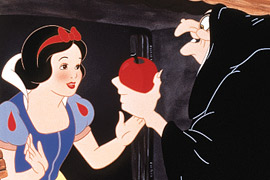 The use of stories is also a means of discovering truths. As in the story of “Snow White and the 7 Dwarfs,” the character, actions and reaction in the narrative give insights into universal truths. The Queen is obsessed with her beauty, is vain, and has much pride. Her true beauty is represented as a witch. On the other hand, Snow White is not concerned with pride or vanity, whereby her virtue causes others to love her, like the “humble” little people (dwarfs). The story reveals that evil cannot kill virtue. Love is more powerful that hate, while showing the roles of vice, virtue, love.
We hear stories, read them in books, and see them in movies. Thru stories, we are transported in understanding to something that cannot be seen with the physical eye. Understanding is a the combination of rationality and good will. (Augustine calls this understanding the “Inner Teacher.”)
Is the story true? An adult’s first reaction may be No, because it didn’t happen, at the surface level, with those particular characters in that particular place in that particular way. But, the story is true, as a narrative medium that has deeper meaning revealing “truth.” Children who haven’t been told stories when they’re little may have a difficult time reading the Bible. We learn to discover truth through stories.
All art, at the surface level, is false. But it allows you to look beyond the surface to discover a deeper truth. Rhetoric is the use of knowledge (with eloquency) for a moment of insight. All of these means of story telling, literature, rhetoric, art and music shows how language guides us into truth, through revealing insights, discovery of meanings and universals.
Silence is a moment of pause in language, used to reflect on and understand insight. We must allow silence to guide us to discover of meanings.
How do we know history? Through parents, teachers, books, stories, etc. The past no longer exists, but we reflect on memory and recollection to remember its truths. Our recollections bring presuppositions that we must learn to identify and remove in order for universal truths to be revealed. We have “thematic” presuppositions that are explicit and fully conscious of. We also have “non-thematic” presuppositions that are implicit and ingrained in us that we must learn to identify. In order to come to real “truth,” we must identify what our “natural standpoint” is, that becomes our reference point, pull of presuppositions, to discover the universals of truth for our lives.
my SJVCS bros Anthony U & Greg V
Our seminary website here at St John Vianney College Seminary has a new blog that features 2 of my brother seminarians posting “a day in the life” of a seminarian. Check them out! Anthony Ustick (2nd Year Junior) and Greg Visca (2nd Year Sophmore).
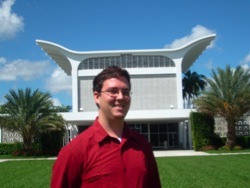

Greg is also the one in charge of the new blog, so let him know what you think.
Cuban food night
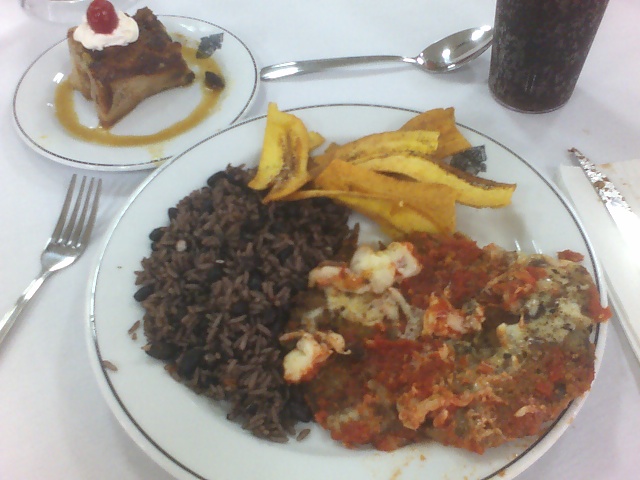
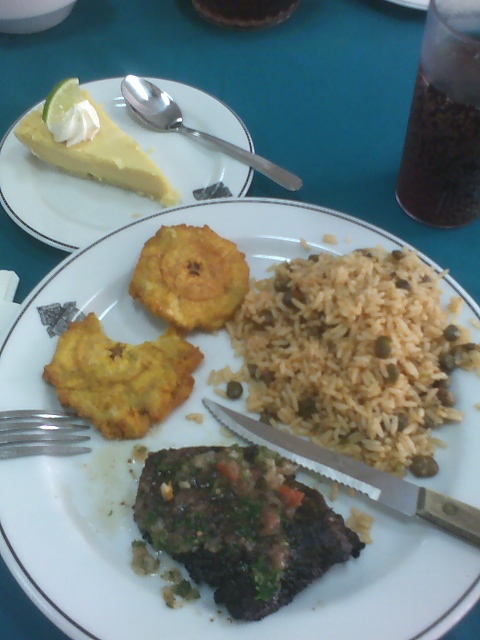
CULTURAL FOOD NIGHT — Tonight was Cuban food night. Great food!
beach day @ Bill Baggs
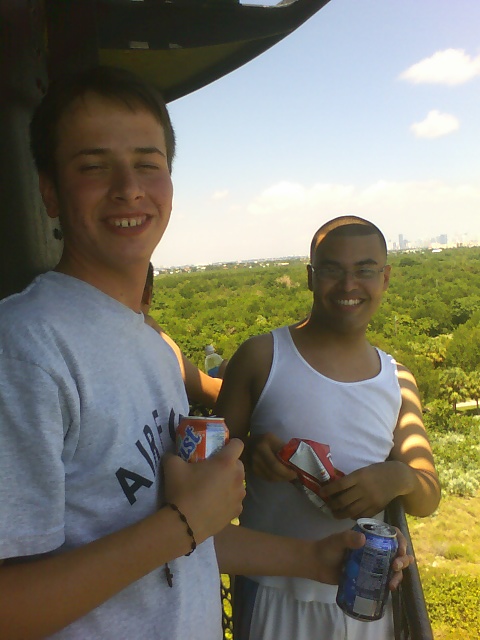
Every few weeks, Fr Michael [rector] has an optional social trip on Saturdays. Today was a beach day at Bill Baggs State Park in Key Biscayne, Florida. Perfect weather, perfect food, perfect company. It was perfect! — except for my sunburn






ultimate frisbee
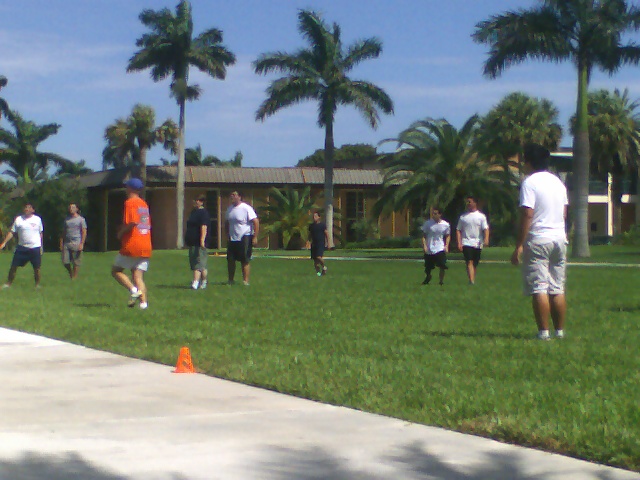
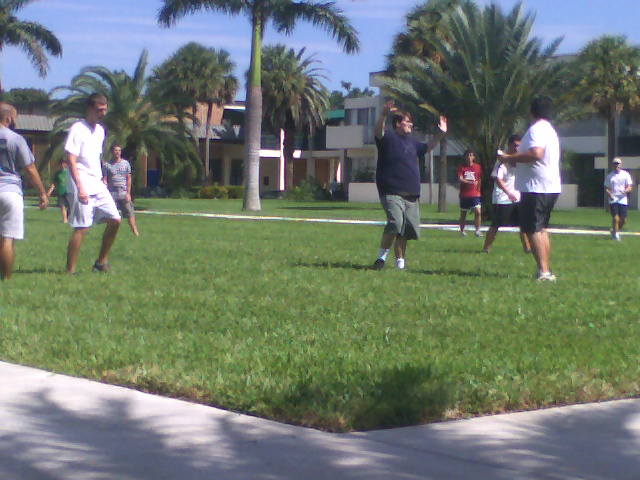
Friday afternoon usually has some outdoor team sports like soccer, baseball, flag football. Today is Ultimate Frisbee. I did not part and covered for someone.

student government
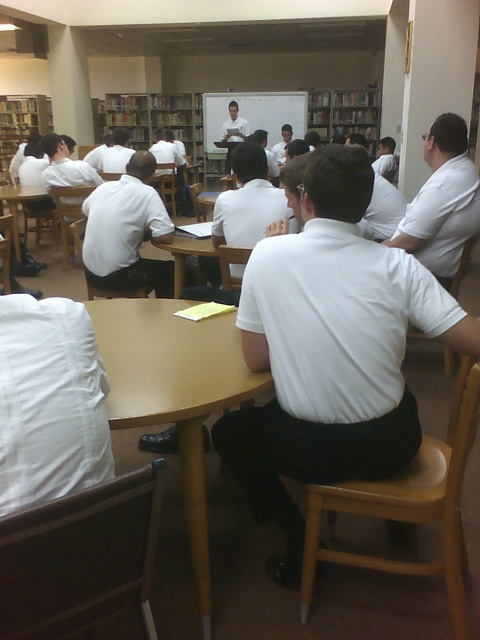 Today was our first Student Council meeting for the year. We elected Deans and Vice-Deans for each class level. We also discussed several open forum issues with lots of feedback. — hear ye hear ye
Cup + new jefe + happy holy hour
 EUCHARISTIC MINISTERS — At this morning’s Mass, 14 of us Seniors & second-year Pre-Theology (me) seminarians were installed as Eucharistic Ministers to our seminary community here at St John Vianney College Seminary. We’ll be assisting especially with distribution of the Cup of Precious Blood at Mass. An honor and reminder of our greater role to lead and be example to our fellow brothers in priestly discernment.
NEW WORK LIST JOB — Every Wednesday 1:30 to 3pm, we each have a “job” to do for the community. This semester I am the “Assistant Work List Coordinator.” I drive around with my “jefe” coordinating needs and supplies for each area of Work List (Carroll Building, McCarthy House, Chapel, Library, Offices, etc.).
other DOTS — Wendy’s 4 — Rector personal intro meeting — joyful Holy Hour — Cuban dinner — John Adams part 5
Socrates balance of happiness + true humility
FUNDAMENTAL ETHICS – (Fr Vallee) — Ethics of Plato vs Aristotle. Plato’s Philebus & The Republic.
Ethics for Plato is (1) eudaemonological (“Happiness for each and every creature consists of possession of the hightest good to which his or her nature has access.” ), (2) intellectual (virtue = knowledge, sin = ignorance), and (3) formalism, absolutist (circumstances don’t matter, we must contemplate the forms, anamnesis).
Ethics for Aristotle is (1) eudaemonological, (2) practical (habit), and (3) consequentialist (virtue-based).
Pleasure is a result of good, not good a result of pleasure. To Socrates, happiness is a balance of many needs and desires, with a perfect balance of the soul among beauty, proportion and truth.
A great quote from Frances de Sales … “true humility is to see yourself as you are seen in the eyes of God, not more than you are and not less than you are.”
be a “good” finder
MASS – (Fr Michael) — We need to be transformed and renewed to have the mind of Christ. Seminary life can get frustrating, especially living here with 60+ guys. We can get caught up in the complaint and “tearing down” our brothers in Christ. Instead … we need to diligently “build up” our brothers and be “good finders” to encourage others, sometimes even to acknowledge the blessings and graces we see with words of encouragement. — assignment: each day this week, be a “good finder” to my brothers
mumbo jumbo + find myself
MASS – (Fr Santos) — in seminary, sometime our discernment process can be challenging enough to even “feel formation.” Studying philosophy can seem like a lot of mumbo jumbo. But … Consider this is something God wants you to do, leading us to the person God wants us to become. — the growing pains of formation while discerning my vocation
don’t be an armadillo + move!
 MASS – (Fr Alvarez) — [told story of bladder cancer] We see lots of dead armadillos on the side of the road here in Florida. Why? Armadillos are blind and role up into their hard shells when they hear danger approaching … thus, the traffic incidents. As we grow in anything in life, challenges to leave our comfort zone can bring fear that can paralyze us from moving forward to something even greater, if we keep going. The formation process in seminary discernment presents challenges to ourselves that need to be faced and embraced … but with prayer and perseverance … not fear … don’t be an armadillo! — I’ll try
the Church
RECTOR’s CONFERENCE – (Fr Michael) — tonight’s topic: THE CHURCH
I. GENERAL INTRO
A. Difficulties of Definition
1. Paul: EKKLESIA – a gathering of a group — a group of believers gathering “in the Lord” — local community gathering
2. Attempts at Definition
a. Baroque needs — tried to make mysteries visible & concrete
b. Externals
c. Risk of polarization
d. Search for clarity has a price — risk losing the presence of God
3. Subject of Mystery
a. innermost reality of Church is a divine gift, itself
b. Church is communion of men through grace of Christ
c. mystery
d. connaturality / intersubjectivity — we cannot objectify the Church because we are a part of it
e. mystery of Christ
4. Use of models
II. CARDINAL AVERY DULLES + MODELS OF THE CHURCH
A. Intro / Context
B. Original Models
1. Institutional – visible structure, right & powers of its officers
a. Negatives: can become rigid, doctrinaire,
b. this should never be the first or primary model
2. Mystical Communion – people united by the spirit in Christ, spiritual, communal, personal
a. Negatives: can lead to disillusion, simply “a friendly family of believers”
3. Sacrament – a sign & transmitter of God’s grace in the world, connects outward institutional & inner mystery
a. Negatives: can lead to “sterile aestheticism” (overly spiritualized)
b. this should be the primary model
4. Herard – faith & proclamation of Gospel, focused on preaching, share gift with others
a. Negatives: can be not incarnational enough, saying & not doing, can be rather pesimistic
5. Servant – part of the whole human family & sharing their concerns
a. Negatives: can seperate from Word & Sacrament, can forget the Church is a community, can disolve things distinct to Christianity
C. Addition of Sixth Model
1. Polarization of 70’s (models were not embraced)
2. “Community of Disciples”
BBQ + water balloons + movie night
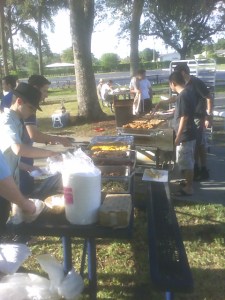
With today being the last day of final exams, we celebrated with a dinner Bar-B-Que, a water balloon fight and movie night with unlimited desserts


final exams done!
Medieval Philosophy final exam
thank you lunch
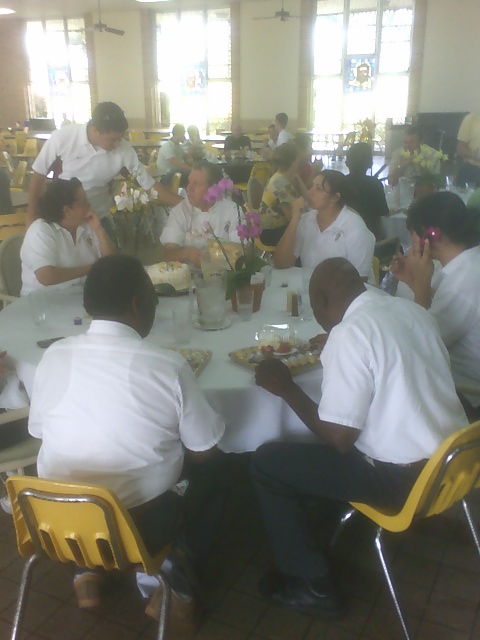 Today was a Kitchen & Service Staff Appreciation Lunch cooked by Fr Vallee and Javier, served by some seminarians for staff here at St John Vianney College Seminary.


SJVCS Seminary Life Album

July '09 -- hospital chaplains @ IPF
Easter '09 -- Miami SJVCS friends

the Son always finds a break in let the clouds

Feb '09 -- school vocation talks @ AMHS

Feb '09 -- cold breakfast with brothers (Matias, Fenly & Randy), now at SVDP and Imad (at SJVCS)

Superbowl '09 -- eating great @ SJVCS

Sept '08 -- Worklist Coordinators?

St Raphael Chapel mural @ SJVCS

Sept '08 -- retreats @ SJVCS

"It's not easy being green"
 Catholic Kermit

Recent Comments