Archive
means well + ethical hero + dualism + Taliban
MASS – (Fr Alvarez) — [an “extremely liturgically strict” priest is a poor example]
AQUINAS – (Fr Vallee) — 3 reasons for studying philosophy: (1) apologetic, (2) dogmatic, and (3) pastoral. Nemo dat quod non habet = no one gives what they don’t have. CCD teacher that only teaches emotion … 8th grader observation: “She means well, but doesn’t mean much.”
 CONTEMPORARY PHIL – (Fr Santos) — finished Kierkegaard‘s Either/Or. The “ethical existence” is choosing to be who and what one truly and uniquely is (a subject, a self, unlike any other self, unlike any other thing). Even though we have many potential directions, TO WILL EVERYTHING IS TO ULTIMATELY WILL NOTHING (one’s energy is dissipated). The self willing involves an ongoing task/process, not a finished product. Negative view of the “mystic.” The “ethical hero” is interested in becoming a “genuine human being” and “honesty to oneself” ready to give up the aesthetic if it classes with the ethical or “for the sake of” something higher. The RELIGIOUS STATE is an intensified version of the ethical, making a relationship with God the highest priority. — need to read Karl Marx Communist Manifesto for Friday.
MEDIEVAL PHIL – (Fr Vallee) — elitism (death penalty debate) + virtue (through humility) + dualism (the Forms eternal are a problem to creation) + Justin Martyr (creation, faith & reason) + Philo the Jew (the Forms are ideas in the mind of God)
WORKLIST — with the rain, the “outdoor guys” were reassigned to help other crews, which made our McCarthy House crew finish even faster.
HOLY HOUR – (Fr Alvarez) — Taliban + scandal + “be a man”
DOTS — Next
Solar System distances
 As I study into time travel, I need a better concept of distance, at least in our Solar System. I found a good illustration in chapter 2 of “30 Days to Understanding the Bible” by Max E. Anders (protestant resource). He starts his model in the middle of the Bonneville Salt Flats in Utah. Here it goes:
(Sun) a beach ball – 2 feet in diameter — at the center
(Mercury) a mustard seed — walk a city block away
(Venus) a BB — walk another city block away
(Earth) a pea — walk another city block away
(Mars) a mustard seed — walk another city block
(asteroid belt) sprinkle some grass around
(Jupiter) an orange — walk a quarter of a mile away
(Saturn) a golf ball — walk another third of a mile
(Uranus) a marble — walk a mile away
(Neptune) a cherry — walk a mile away
(Pluto) a marble — walk another 2 miles away
This model is about 10 miles in diameter from Sun to Pluto. Now, to better understand distance even better, let’s place Alpha Centauri (the next nearest star to our sun) with another beach ball 6,720 miles away from the “Sun” in Japan.
This is not only helpful with concepts of science. Understanding the size, location and distances give us perspective into geography. This is also an important concept when studying Scripture. It is helpful to know names, locations and distances between important geographical locations, otherwise comprehension gets lost or ignored, leaving our faith to appear unrelevent and archaic. We should embrace the sciences to glorify God. — plus it’s kinda cool!
Déjà Vu & time travel
 After watching the movie Déjà Vu (with Denzel Washington), I got to thinking about the theory of time travel:
Many in the scientific community believe that backwards time travel is highly unlikely. Any theory which would allow time travel would require that issues of causality be resolved. What if one were to go back in time and kill one’s own grandfather? (see grandfather paradox) Additionally, Stephen Hawking (Homer Simpson called him “Wheelchair Guy“) once suggested that the absence of tourists from the future constitutes an argument against the existence of time travel—a variant of the Fermi paradox.
The more theories I read, including wormholes and traveling faster than the speed of light, the more impossible is sounds. Let’s get real. If the speed of light is 3 x 10^8 m/s or 186,282 miles/sec, how can we get the human body to move that fast?

SJVCS Seminary Life Album

July '09 -- hospital chaplains @ IPF
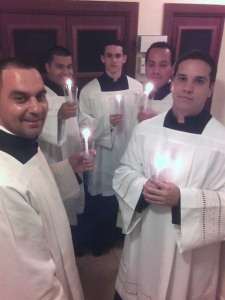
Easter '09 -- Miami SJVCS friends

the Son always finds a break in let the clouds

Feb '09 -- school vocation talks @ AMHS

Feb '09 -- cold breakfast with brothers (Matias, Fenly & Randy), now at SVDP and Imad (at SJVCS)

Superbowl '09 -- eating great @ SJVCS

Sept '08 -- Worklist Coordinators?

St Raphael Chapel mural @ SJVCS

Sept '08 -- retreats @ SJVCS

"It's not easy being green"
 Catholic Kermit
Recent Comments