Archive
Communion & Liberation
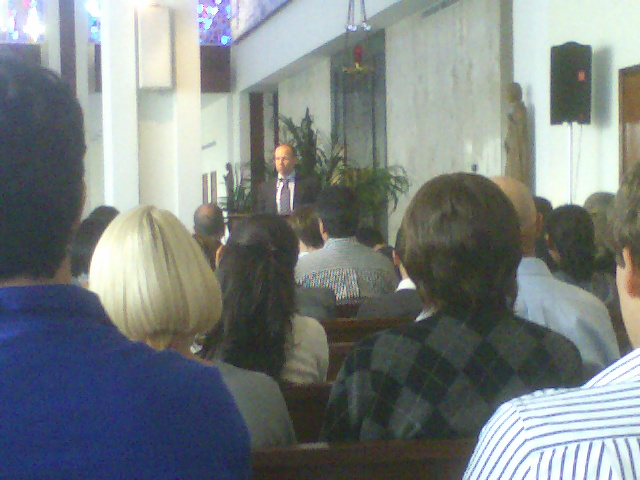 COMMUNION & LIBERATION — this morning was a special presentation in St Raphael Chapel here at St John Vianney College Seminary. We had a keynote speaker, Christopher Bacich, leader of Communion and Liberation in the USA, introducing the latest book by founder Luigi Giussani called “Is It Possible to Live this Way?” The lay ecclesial movement, “CL” for short, is worldwide with an active presence here is South Florida. There are regular meetings nearby the seminary, that do small group spiritual readings (from Luigi Giussani’s books) and discuss their faith experiences together. Besides priests (like Fr Chris Marino, spiritual director here & pastor of Visitation Parish) and religious who belong to the movement, the movement has consecrated lay men and women who are committed to lifelong celibacy, known as the Memores Domini, who keep things going (one man lives down the street from the seminary).
 The regular group meetings are called School of Community. [from flyers they handed out:] In it, participants learn to perceive the sense of the Mystery, upon which our life depends, and to live the Catholic faith through a companionship within everyday life. Community life is built through the School of Community, a weekly meeting open to everyone (no membership is needed) and held in places such as high schools, universities, parishes or workplaces with study and discussion about a text. The text (the same for all communities around the world) communicates the experiences of Father Giussani’s charism in a systematic form that helps us understand our lives and life of the Church and of the world. In South Florida, here are the current locations for meetings:
For High School students:
-
Columbus High School (3000 SW 87th Ave., Miami, FL 33165), Classroom D16, Friday at 4:30pm. Contact Paolo Cazzoletti (paoloc90@hotmail.com).
-
St Thomas Aquinas High School (2801 SW 12th Street, Fort Lauderdale, FL 33312). Contact Tommy (tmaranges@hotmail.com) or Simone (simone_brusa@hotmail.com).
For College Students & Professors:
-
Miami locations to be announced, Friday at 7pm. Contact Luis A. Rivero (pater33@gmail.com).
-
Ave Maria University. Contact Brendon Ford (Brendon.Ford@avemaria.edu) or Naomi Amsbery (naomi.ambsberry@avemaria.edu)
For Adults:
-
Visitation Parish (19100 North Miami Avenue, Miami, FL 33169) in activity room, Tuesday at 7:30pm. Contact Elena Nunez (evnunez@bellsouth.net).
-
NEW School of Community beginning in South West Miami. Location and time to be determined. Contact Eduardo & Martina Stadelmann (martina.stadelmann@gmx.net or 305-495-7597).
 More info about Communion and Liberation on Wikipedia, CL USA website and CL international website. Apparently, Pope Benedict XVI has been a supporter of this movement back when he was Cardinal Ratzinger and has his own weekly meetings on Saturdays at the Vatican.
The event ended with a beautiful bi-lingual Mass with Archbishop Favalora, another great supporter of the CL movement, especially here in South Florida. — a great presentation by Fr Chris Marino and guest speaker Christopher Bacich (“Einstein of love”) 🙂
Communist Manifesto + lost weekend + homosexuality
 HOMEWORK CATCH-UP — behind on some assigned reading, I spent some of the day reading The Communist Manifesto by Karl Marx for Contemporary Philosophy class tomorrow.
PRE-THEOLOGY UPDATE — (1) the chapels in our off-campus housing should be done in about 4-6 weeks. (2) Since we raised concerns about feeling distant from the campus community, our personal “free-weekend-a-semester” opportunity has been rescinded. (3) Our house will have resident priest in a couple weeks. (4) Our backyard furniture has no status yet.
RECTOR’s CONFERENCE – (Fr Michael) — part 3 of a series on Fatherhood titled after a 2005 Vatican document, “The Instruction on the Criteria for Vocational Discernment with Regard to Persons with Homosexual Tendencies in View of Their Admission to the Seminary and Holy Orders.” [full text of document]
PRE-THE NIGHT PRAYER & ROSARY — 10pm.
INCONSISTENT SCRIPTURE — as I’m practicing tomorrow’s Mass reading (I have lector duty), there are 2 passages to choose from since it’s the feast of the Conversion of St Paul. There’s a detail in both that is inconsistent. In one reading, when Paul is blinded by the light and hears Jesus speak to him, his companions “heard the voice” of Jesus … but in the other passage, they “did not hear the voice.” I tried finding some footnotes in various Bible versions, but only found a note in the NRSV that noted the inconsistency, but didn’t give any possible explanations. — I need to look up a comentary in the library
synoptics + Mark + Matthew + Columbian food + pro-life Rosary
MASS – (Fr Santos) — “the sabbath was made for man , not man for the sabbath”
SPANISH 2 – (Dr Jimenez) — chapter 15 on haber + past participles. If we stay on schedule this semester, we’ll try to read the Spanish version of The Lion, the Witch and the Wardrobe.
 NEW TESTAMENT – (Fr Michael) — today, we started the Synoptic Gospels (reviewed side-by-side syn-optically), more specifically the Gospels of Mark & Matthew. Even though Mark is the shortest gospel book, 80% of Mark’s verses are reproduced in Matthew while 65% is in Luke. There may also exist a hypothetical source “Q” that scholars propose to explain other similarities between Matthew & Luke not borrowed from Mark.
CULTURAL FOOD NIGHT — today was Columbian food night with a small army of cooks creating some great food.


PRO-LIFE ROSARY — after dinner in the McCarthy Chapel on the anniversary of Roe vs Wade for the dignity of all human persons, especially for the end to abortion.
beast of burden + men are right + Unknown God + body theology
 MASS – (Fr Michael) — today’s Mass intention was for Pope Benedict XVI, very appropriately with the Gospel reading of Jesus telling Peter to “Feed My Sheep.” The story behind the significance of the Corbinian Bear on the Pope’s coat of arms (upper right) was told. According to the background on Saint Corbinian (a Frankish bishop), a bear killed his pack horse on his way to Rome so the saint commanded the bear to carry his load. Pope Benedict XVI first adopted the symbol when, still known as Joseph Ratzinger, he was appointed Archbishop of Freising-Munich in March of 1977. He retained the bear in his revised coat of arms when becoming Cardinal in the same year and when elected to Pope in 2005. In addition to the obvious reference back to St. Corbinian, the founder of the diocese where Benedict was bishop, the bear represents Benedict himself being “tamed by God” as a “beast of burden” to bear the spiritual burdens of Benedict’s own ministries first as bishop, then as cardinal, and now as pope.
AQUINAS – (Fr Vallee) — more on Modernity and the extremes of Rationalism (reason) & Fideism (faith). Nature + supernature. Grace + nature. Samuel Taylor Coleridge quote: “Most men are right in what they affirm, and wrong in what they deny.”
CONTEMPORARY PHIL – (Fr Santos) — opening quiz on reading of Kierkegaard‘s “Equilibrium between the Aesthetic & the Ethical” in his book Either/Or. Introduced “inauthentic existence,” “radical subjectivity,” “disolving into a mutitude,” and self as “task” & “a dynamic process.”
 MEDIEVAL PHIL – (Fr Vallee) — reviewed Stoicism and reflected on St Paul in Athens (Acts 17), especially his approach to preaching the gospel message among the Greeks of his time about their statue to the “Unknown God.”
MINISTERIAL METHODS – (Fr Michael) — “Classroom Management.”
RECTOR’s CONFERENCE – (Fr Michael) — usually on Thursday, this was an exceptional day since this Thursday we’re hosting the seminarians from the St Vincent’s Major Seminary in Boyton Beach, FL. Today’s topic was (part 2 of 3) on the Pope John Paul II’s Theology of the Body.
DOTS — night walk — Superman Returns — busy day
practical atheism
On the first day back to seminary after a 2 week Christmas break, the Rector Fr Michael had a Rector’s Conference disguised as an “Orientation Meeting” with some great points to think about as we begin a 4 day silent retreat tonight.
Beware of “practical atheism” when we say our prayers … and don’t live them.
Christianity is a lifestyle, not just an idea. C.S. Lewis quote: “For when you get down to it, is not the popular idea of Christianity simply this: that Jesus Christ was a great moral teacher and that if only we took His advice we might be able to establish a better social order and avoid another war?” [from chapter 23 of Mere Christianity]
Pope Benedict XVI quote on priesthood:
The priest must be a believer, one who converses with God. If this is not the case, then all his activities are futile. The most lofty and important thing a priest can do for people is first of all being what he is: a believer. Through faith he lets God, the other, come into the world. And if the other is not at work, our work will never be enough; When people sense that one is there who believes, who lives with God and from God, hope becomes a reality for them as well. Through the faith of the priest, doors open up all around for people: it is really possible to believe, even today. All human believing is a believing-with, and for this reason the one who believes before us is so important. In many ways this person is more exposed in his faith than the others, since their faith depends on his and since, at any given time, he has to withstand the hard-ships of faith for them….
There is a mutual given-and-take in faith in which priests and lay people become mediators of the nearness of God for one another. The priest must also nurture the humility of such receiving in himself ….
The first “task” a priest has to do is to be a believer and to become one ever anew and ever more. Faith is never simply there automatically; it must be lived. It leads us into conversation with God which involves speaking and listening to the same degree. Faith and prayer belong together; they cannot be separated. The time spent by a priest on prayer and listening to Scripture is never time lost to pastoral care or time withheld from others. People sense whether the work and words of their pastor spring from prayer fabricated at his desk. [Cardinal Joseph Ratzinger, from A New Song for the Lord, tr. by Martha M Matesich, NY: Crossroad Publishing Co., 1996, and quoted in Magnificat for Holy Thursday, March 24, 2005.]
[Other links not mentioned today …The Nature of Priesthood (1990 speech by Cardinal Joseph Ratzinger) … Pope Benedict XVI’s Homily to Seminarians in Cologne: “If You Abide in Christ, You Will Bear Much Fruit” (August 19, 2005 World Youth Day Meeting)]
According to St John of the Cross, few will have an ecstacy prayer experience. Opening poem of his Dark Night of the Soul [insert here].
Ended with a guided meditation, “Feed my sheep.”
prosperity gospel = pyramid scheme
 FoxNews reports that there is a senate investigation targeting six ministries promoting the “Gospel of wealth” to innocent victims. — Finally somebody is calling their bluff … but nothing will be done about it.
Prosperity theology is commonly a part of televangelist, charismatic, and Pentecostal churches, that highlights the idea that God wants Christians to be “abundantly” successful in every way, including financially. It’s loosely based on Deuteronomy 8:18, “Remember the Lord your God, for it is he who gives you power to get wealth, so that he may confirm his covenant that he swore to your ancestors, as he is doing today.” In a nutshell, it suggests that a God who loves you does not want you to be broke. Some of the evangelists supporting prosperity theology include Kenneth Copeland, Benny Hinn, Nasir Saddiki, Robert Tilton, T.D. Jakes, Paul Crouch, Joel Osteen, Creflo Dollar, Joyce Meyer, Jesse Duplantis, Juanita Bynum, Eddie Long, Brian Houston, Paula White and Peter Popoff, and internet evangelist Chris Mentillo. Pat Robertson calls this theory the “Law of Reciprocity” on his show, The 700 Club[2].
Critics, including CATHOLICS, claim that the doctrine is used by its proponents to become wealthy at the expense of persons who give or that the doctrine’s focus on material wealth is misguided. In my view, I sounds like a glorified “Pyramid Scheme.” If our goverment is starting to look into this, why stop there Senators? Wall Street does this on a daily basis. Vegas and all the lotteries that are under government control do the same thing, promise the moon to lure a victim’s coin. — That’s why nothing will be done.
 This got me looking for the Vatican’s guide to tithing our 10%, but I haven’t found anything official. Anybody know what the Catholic Church says about tithing? — Kermit?
Pope to Baptists
 I ran across a short speech Pope Benedict XVI gave to the ecumenical council for the Baptist World Alliance on December 6, 2007. Here’s an excerpt (the last line is deep):
As believers in Christ, we acknowledge him as the one mediator between God and humanity (1 Tim 2:5), our Saviour, our Redeemer. He is the cornerstone (Eph 2:21; 1 Pet 2:4-8); and the head of the body, which is the Church (Col 1:18). In this Advent season, we look to his coming with prayerful expectation. Today, as ever, the world needs our common witness to Christ and to the hope brought by the Gospel. Obedience to the Lord’s will should constantly spur us, then, to strive for that unity so movingly expressed in his priestly prayer: “that they may all be one… so that the world may believe” (Jn 17:21). For the lack of unity between Christians “openly contradicts the will of Christ, provides a stumbling block to the world, and harms the most holy cause of proclaiming the good news to every creature” (Unitatis Redintegratio, 1).
where’s Heaven?
 A thoughtful closing to Pope Benedict’s 2007 homily at Midnight Mass (reposted by Fr Stephanos, OSB on his blog Me Monk Me Meander).
In the stable at Bethlehem, Heaven and Earth meet. … Just as the sinner is called ‘Earth’, so by contrast the just man can be called ‘Heaven'” (Sermo in monte II 5, 17). Heaven does not belong to the geography of space, but to the geography of the heart. And the heart of God, during the Holy Night, stooped down to the stable: the humility of God is Heaven. And if we approach this humility, then we touch Heaven. Then the Earth too is made new. With the humility of the shepherds, let us set out, during this Holy Night, towards the Child in the stable! Let us touch God’s humility, God’s heart! Then his joy will touch us and will make the world more radiant. Amen.
must read Bible
 I stumbled upon this graphic while looking for a grocery list [it’s my new Pre-T house job to keep food stocked]. It instantly reminded me of one of my favorite Scripture passage, that I would teach on the first day of 7th grade Pre-Confirmation classes. Hebrews 4:12-13 says,
Indeed,the word of God is living and active, sharper than any two-edged sword, piercing until it divides soul from spirit, joints from marrow; it is able to judge the thoughts and intentions of the heart. 13And before him no creature is hidden, but all are naked and laid bare to the eyes of the one to whom we must render an account.
I also recall a newsflash I read in the Florida Catholic this week about Pope Benedict XVI urging Christians must read the Bible. He highlighted St Jerome’s famous line, “ignorance of Scripture is ignorance of Christ.” — we can never say it enough
Divine Mercy Mass
 MASS — today, the Miami seminarians were asked to serve/join Miami Auxiliary Bishop Estevez’s Mass for the spanish Divine Mercy Conference going on this weekend including some Sisters from Polish Saint Faustina’s order. A beautiful service. — I left my camera phone in my room … the pictures would have been nice.
volunteering @ Convenant House
 I went for a volunteer interview at Convenant House (shelter for runaway teens) today. It looks like a great place for kids. They have 100+ bed capacity with kids of all different backgrounds. I noted I was interested in the pastoral ministry they have, but was open to whatever area they could use me for. The big question? My schedule. I know seminary life is primary, but I would like to challenge my ministry experience to try to be “all things to all people,” as the priesthood entails. Covenant House was started by a Catholic priest and I really like the mission statement:
Mission Statement: We who recognize God’s providence and fidelity to His people are dedicated to living out His covenant among ourselves and those children we serve, with absolute respect and unconditional love. That commitment calls us to serve suffering children of the street, and to protect and safeguard all children. Just as Christ in His humanity is the visible sign of God’s presence among His people, so our efforts together in the covenant community are a visible sign that effects the presence of God, working through the Holy Spirit among ourselves and our kids.
The kids really need “regular” pastoral ministry, so creating a fixed schedule will be crucial, even if it is every other week (Sat or Sun). If I do find time to volunteer, I’d probably get to know the kids in some other position, like “activities” or “intake.” — We’ll see.
As I mentioned that I start seminary tomorrow, it’s starting to hit me … I’m not ready (packing)!
Covenant House
I finally filled out the volunteer application for Covenant House, a Catholic shelter for homeless teens (under age 21) on Ft. Lauderdale beach. They’ve been looking to fill a “Pastoral Minister” position for years, but only recently found someone for the last couple of months. They organize spiritual activities like prayer services, council, Bible study, and take kids to church (of various faiths). It sounds like a difficult, but very necessary service for these teens.
After last months YES Retreat, which had a speaker from Covenant House, I decided to see if I could volunteer some time on the weekends, especially since our youth group is no longer active. While trying to get to the place today, the police had 2 blocks around the building blocked off — I thought it was a hostage standoff. Apparently, a dump truck driver knocked over some electrical poles and cause a major power outage. Of all days that I pick to go!
Just to top things off, I found out the new “Pastoral Minister” is leaving in a couple of weeks. — These kids just can’t get a break!
Miami seminary – part 2
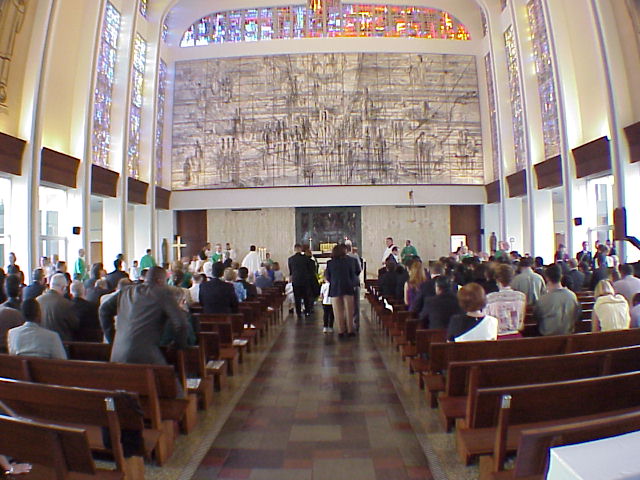 After my last post, I got a response from a former student at St. John Vianney Seminary High School in the 1970’s. He hosts a website to track former students and faculty to see where they are now. He has some great historical info and pictures about the campus. Apparently, the school used to teach young men in 9-12 grade from 1959 to 1975. It has some great pictures of St. Raphael Chapel (pictured here) from the 40th Anniversary in 1999. —nice.
military Catholics
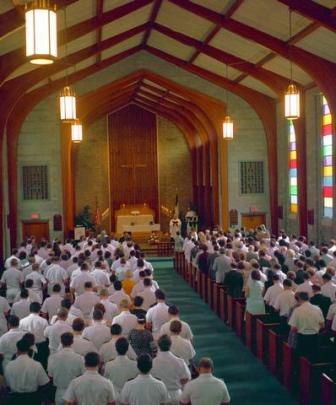 In the July edition of the Knights of Columbus monthy Columbia magazine, I found an article profiling Catholic American soldiers. There are an estimated 300,000 Catholic in the U.S. armed forces, most of them age 18-29. While the number of baptized Catholics in the military (28%) reflects the general population — only about 5% of them are regular churchgoers.
Military life entails peculiar demands. Many are away from home for the first time — preparing for action or stationed in a war zone. They face increased responsibilities and family pressures unlike any in civilian life. Changes in deployment happen at a moment’s notice. Young married couples often face the strain of long-term separations. They often have little contact with chaplains, whose small numbers (only 8% of all chaplains) cannot meet ministerial demands.
In ALL of the U.S., Catholic young adults ages 18-30 attend Mass more — 21% every week, 35% at least once a month, 28% a few times a year, and 15% rarely or never. At first, I thought that during wartime, a soldier seeking a refuge from battle would pursue a hunger for faith & spirituality even more than a civilian. But after considering all the pressures they face, I can understand the difference in the numbers.
 In response to these number, the Military Archdiocese of the U.S., led by Archbishop Edwin F. O’Brien, initiated a program called Catholics Seeking Christ (CSC). The 1 year old program, funded by the Knights of Columbus, uses small groups and peer ministers to strengthen the Catholic identity of military personnel. They use extensive resources, including DVDs and CDs. I pray for the success of their efforts and for ALL our troops. — it sounds like a program I’d like to be part of.
military prayers
 In the July edition of the Knights of Columbus monthy Columbia magazine, I found a 64-page Catholic prayer booklet called, “Armed with the Faith: A Catholic Handbook for Military Personnel.” It features traditional prayers, devotions, hymns, catechism and more. The military version is a 5×7-inch waterproof and tearproof booklet. The civilian version is on paper and can be downloaded here in Acrobat pdf format (333 KB). It’s available directly from the Knights. I also found it available for only $1 at an online Catholic store called GodSpace.biz. I might just have to get these for our Confirmation kids next year. — but I want one first!
Trespasses
 I was looking for some seminarian blogs on WordPress and found a thoughtful (maybe too much so) blog about the line in the Lord’s Prayer, “Forgive us our trespasses, as we forgive those who trespass against us.” JustJen, a Protestant seminarian/minister writes:
… To trespass is something so much more powerful than to sin or to be in debt. If you have sinned, you’ve done something wrong. If have a debt, you owe someone something. If you have trespassed, you have been wandering around in places you do not belong. You’re traipsing, searching, stomping. Whatever you’re doing, you weren’t invited. You are where you do not belong.
You’re lounging underneath the forbidden tree waiting ignorantly for another piece of forbidden fruit. Your gaze is fixed on the wrong .com. Or your heart is fixed on absolutely nothing but yourself. You live on the couch or under your covers or in the closet or in the bar.
You’re backseat driving someone else’s life. You help them blur the sacred and profane. You violate their spaces, their senses and their self-esteem.
You have gone where you do not belong. You have trespassed. Against God. Against others. Against yourself.
Turning around and climbing back over the barbed wire fence or quietly sneaking out the back door will not help. When you go where you do not belong, damage is done even if you don’t see it yet. Property gets destroyed and trust gets violated. You can’t just say I’m sorry or try to pay it back.
See? I can apologize and I can pay back anything I owe. But when I have trespassed, it’s just too complex. There’s no way I’m getting out of it and no way everything can be made whole and right outside the help of Christ.
She’s too deep for me. I think she’s saying a trespass is worse than just a sin, but I don’t see it. — Anyone else? Kermit?
“holiness” in Rise … by John Paul II
 With a bad rainstorm (drought-relief) today, I started re-reading John Paul II‘s book, “Rise, Let Us be on Our Way.” Although it mainly reflects on his journey to and through becoming a bishop, it is written for everyone. It’s a simple read with great personal insight and advice for all Christians. Here are some points I highlighted from the Ordination Liturgy parts of “Vocation” (section 1):
At a priestly ordination, the hands area anointed; at an episcopal [bishop] ordination the head is anointed. This signifies the call to new responsibilities: the bishop will have the task of guiding the Church, which will palce great demands on him. … The ring on the bishop’s finger signifies that he is married to the Church, the sign of fidelity … to protect the holy Church, bride of Christ. … The Book of Gospels is given to remind of a bishop’s calling, to not only serve, but he must be a teacher. … The miter is a reminder of his commitment to let the “light of holiness shine in him” like a “city on a hill” (Mt 5:14) to be “a living example to the flock” (1 Pet 5:3). … The crosier is a sign of the authority that enables the bishop to fulfill his duty to care for his flock.
Outside of the cool symbols, what really struck me was the personal call to holiness that ALL need to find.
The essential meaning of holiness is that it is always personal, and that each and every man is called to it. All members of the people of God are called, but each is called in a unique and unrepeatable manner. … A shepherd must watch, protect and lead every sheep to discover that holiness is not “some kind of extraordinary existence, possible only for a few ‘uncommon heroes’ of holiness. The ways of holiness are many, according to the vocation of each individual.” What a great potential of grace lies dormant in the vast numbers of the baptized!
— I can say no more.
“follow me” & trust
 Today’s readings spoke directly to me. In the first reading (1 Kgs 19:16b, 19-21), Elijah (directed by the Lord) called Elisha to follow and succeed him as a prophet to the people. Elisha recognized God’s call and left his life, sacrificed (literally), and did God’s will wholeheartedly, knowing a prophet’s life is miserable (but the retirement benefits are out of this world).
Then, in the Gospel reading (Lk 9:51-62), some disciples tell Jesus, “I will follow you wherever you go.” (–easier said than done) When some start to hesitate, Jesus reminds them, “… go and proclaim the kingdom of God.” They declare they’re willing, but don’t give up their old lives to respond to the call. Jesus sums up with “No one who sets a hand to the plow and looks to what was left behind is fit for the kingdom of God.”
I need some clarification here! The basic message seems to be the first commandment, “trust God wholeheartedly without reservations.” But the fine print seems blurry. How “blindly” are we to follow “God’s will.” It seems to be a extremist’s motto. It’s demanding, unquestionable and instantaneous. Where’s the discernment process?
As we discern God’s will for the “big” things in our lives, like choosing a vocation to the priesthood, religious life, marriage or the single life, hearing the call is difficult. I guess that’s why discernment takes so long. But how do you know when you have an answer or final decision that has God’s hologram stamp? I’ve heard that some who become priests still have doubts, even after a 6-9 year discernment process. Some closure would be the least you could get for a lifelong commitment. — Is it just me?
Church history, #2 Paul the Troubleshooter
 As I revist the book, The Story of the Church: Peak Moments from Pentecost to the Year 2000, chapter 2 is “First-Century Adjustments,” focusing on Paul the Apostle. It has always confused me how Paul was the “go-to-guy” to answer any questions of theology & the Christian life. He wasn’t even one of the original 12 apostles, but spoke with such authority, even declaring himself an apostle. His conversion story (Acts 9) is amazing enough. But even more unbelievable is how fast the Christian community embraced him and bestowed authority to dictate Christian “policy,” an even greater testament to grace and the submission to the Holy Spirit.
Paul is a master cameleon of evangelization, able to adapt the gospel message to any culture. He was well-versed in the Hebrew Scriptures (OT), had a heart for his audience, walked in their shoes, and presented the challenge of the Gospel in their “language.” — everything a Christian is called to do. A great example is Paul’s sermon to the Athenians in Acts 17:16-34. It seems so supernatural … because it is … it’s only possible through the Holy Spirit.
That reminds me of a line from the “Fishers of Men” priesthood video when it’s said, “It’s not natural to be a priest … it’s a supernatural calling.” — You can’t disagree with that.

SJVCS Seminary Life Album

July '09 -- hospital chaplains @ IPF
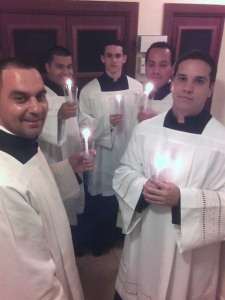
Easter '09 -- Miami SJVCS friends

the Son always finds a break in let the clouds

Feb '09 -- school vocation talks @ AMHS

Feb '09 -- cold breakfast with brothers (Matias, Fenly & Randy), now at SVDP and Imad (at SJVCS)

Superbowl '09 -- eating great @ SJVCS

Sept '08 -- Worklist Coordinators?

St Raphael Chapel mural @ SJVCS

Sept '08 -- retreats @ SJVCS

"It's not easy being green"
 Catholic Kermit
Recent Comments