Archive
last mid-term day + take home exam
After our last mid-term exam, we can go “home” for one week of mid-term break. I still, however, have a take home exam for Contemporary Philosophy that’s due by email by midnight. Six short-answer essay question about Kierkegaard, Marx, Adam Smith, Catholic Social Teaching, and Nietzche. Here’s a couple answers that I’m pretty confident of.
2. (Kierkegaard) What constitutes the most significant difference between the aesthetic and ethical choice? Explain.
The most significant difference between the aesthetic and ethical choice is whether or not someone makes a true choice ‘for the self.’ The more difficult choice is the ‘ethical’ choice, since in involves choosing to be who and what one truly and uniquely is by intimately ‘knowing himself’ with a constant ‘honesty to oneself’ and minimizing the temptations of easier, more convenient decisions. This leads to an authentic existence. One the other hand, ‘aesthetic’ choice leads to an inauthentic existence of compromising true selfhood in order to settle for the convenient outside (external) creating a ‘self lost in the they’ (the crowd, the mob, the inauthentic). Aesthetic choice is lost in the forest of ‘deliberation’ because it is ultimately afraid or simply unwilling to embark on something it fears, ceaselessly jumping from one source of enjoyment to the other, hoping to postpone the inevitable call to ‘be one’s self.” It does not make a true choice ‘for the self’ and, therefore, does not know itself but only thinks it does.
3. Explain the relationship of the ‘individual good’ and the ‘common good’ from the perspective of (i) Marx, (ii) Smith, and (iii) Catholic Social Theory.
(i) Marx minimizes the ‘individual good’ and give priority to the ‘common good.’ Since the human person is a producing, creating person, the individual’s value and importance is defined by our social relations, primarily in terms of economics, politics and society. His focus on the common good encourages policy to benefit ‘everyone’ in, at least, minimal personal needs, but at the expense of the wants of individuals. In his Communist model, the guidelines evidence this emphasis. The abolition of property and inheritances strip the individual of personal power. State centralized credit, banking, transportation, communication, schooling, labor & business oversight creates a dependence by the people to a shared ‘common good,’ but minimizes the unique and personal dignity of the ‘individual good.’
(ii) Smith gives priority to the ‘individual good’ over the ‘common good.’ The individual is empowered with opportunities of self-achievement through Capitalist avenues of mostly personal financial benefit. The ‘individual good’ may compromise the ‘common good’ by gaining such personal benefits at the expense, and from the work, of the poor working class. Even though the growth of the poor affect the individual manager, the extremely disproportional results minimize the personal dignity of needs of ‘all’ individuals. Government measures need to be put in place to somewhat offset the extreme costs to the ‘common good’ for the sake of justice.
(iii) Catholic Social Teaching carefully keeps a healthy balance between ‘individual good’ and the ‘common good.” The ‘common good’ indicates the sum total of social conditions which allow people, either as groups or as individuals, to reach their fulfillment more fully and more easily. A medium of ideas should constantly be pursued so as to uphold the benefits, while working for justice to maintain the dignity of everyone ‘individual good.”
There was a challenging question about how each of our studied philosophers touch on “human transcendence,” but I wasn’t inspired enough to answer with confidence.
biggest Catholic secret + Modern Day Moses (song)
 In Contemporary Philosophy class, our latest discussions have always come back to the treatment of the poor and ignored people in society. Karl Marx‘s Communist Manifesto seems to over-emphasize the poor in his philosophy while Adam Smith‘s The Wealth of Nations seems to minimize them. Fr Santos constantly compared & contrasted Communism with Captitalism with Catholic Social Teaching. He also reminded us of the Catholic Church’s greatest kept secret, the Compendium of the Social Doctrine of the Church that highlights the social teachings of the Church. It’s a great read and good for spiritual reading. [text available on Vatican website here]
As I was seaching YouTube, I also found a video for a song that fits my reflections today. It’s another song by Kendall Payne (one of my favorite Christian vocalist). It’s not that well known, but is probably my favorite of hers to date. It’s off her first album Jordan’s Sister, called “Modern Day Moses.” Here’s the lyrics:
a modern day Moses, waking the streets
with shouts of glory, blistered feet
he’s met the maker, he’s met the reason he’s alive
and he’s on fire inside

a modern day mother, living in the slums
feeding the hungry, making sure the race gets run,
always asking if we fought with steady feet
she fights on her knees
let my people go (4x)
a modern day Martin in a world of civil words exchange
but dreaming bigger, thinks maybe he could make a change
he’s heard the stories, he wants some of his own
and he’s not alone. (no, no, no ...)
[chorus]
(bridge)
the time is not the moments here,
walk in faith or stand in fear
change the course of history,
did you ever think, no one ever though
— who would have believed?
a modern day Me, what have i become, what can i be?
if there is greatness out there to be achieved
i want to be more than someone who just passes through this life
i want to stand up for what is right
[chorus]
The YouTube video (above), featuring Kendall Payne’s song Modern Day Moses, is just a collage of scenes from 7th Heaven of people that the Camden family has helped over the years. I’ve never been a big 7th Heaven fan, but charity is a great running theme for this post, so it’s ok here! 🙂
semester begins + Aquinas + Contemporary Philosophy + Medieval + Ministry + Amber Spyglass
MASS – (Fr Michael) — God is the same yesterday as today, on vacation, on retreat, back in the daily routine. Do you believe in Jesus? How is your life different because of your belief?
AQUINAS in the 20th CENTURY – (Fr Vallee) — this is a senior level course that focuses on the rediscovery of St Thomas Aquinas thought in the 19th & 20th centuries, in the areas of epistemology, metaphysics and anthropology. Readings will be from Gilson, Maritain, Marechal, Rousselot and John Paul II’s Fides et ratio. No term paper. Tests are open notes & open book — (translation: It’s hard!). Large class.
CONTEMPORARY PHILOSOPHY – (Fr Santos) — started reviewing Modern Philosophy era. LOTS of reading. Martin Buber – I and Thou … Hans-Georg Gadamer – Truth and Method … Martin Heidegger – Introduction to Metaphysics … Edmund Husserl – Phenomenology and the Crisis of Philosophy … Soren Kierkegaard – Either/Or (our first reading assignment) … Karl Marx – Communist Manifesto … Friedrich Nietzsche – The Anti-Christ … Paul Ricoeur – Oneself as Another … John Robinson – Honest to God … Adam Smith – The Wealth of Nations … Alfred North Whitehead – Religion in the Making. — I should probably be reading right now!
MEDIEVAL PHILOSOPHY – (Fr Vallee) — reviewed a timeline of philosphy periods. This class will focus on Augustine (Confessions), Anselm, and Thomas Aquinas (Summa Theologica, On Being and Essence, The Thought of Thomas Aquinas). Our main test is Frederick Copleston’s A History of Philosophy, vol II. 2 papers. — finally some Augustine & Aquinas!
MINISTERIAL PRACTICUM – (Fr Michael) — reviewed the basic about ministry (from last semester). This course will be about the practical skills need for ministry. Next year, we’ll be assigned Monday night “Apostalic Work” in the areas of CCD catechesis or Homebound Visitation. We’ll be going out to visit other seminarians in their work assignments throughout the semester. Today, we also learned “How to Create a Lesson Plan” for CCD class. — finally some hands-on!
DOTS — “Kr” Lauds blessing — listened to first half of The Amber Spyglass (His Dark Materials trilogy) on audio

SJVCS Seminary Life Album

July '09 -- hospital chaplains @ IPF
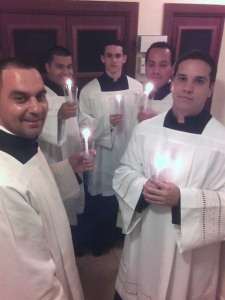
Easter '09 -- Miami SJVCS friends

the Son always finds a break in let the clouds

Feb '09 -- school vocation talks @ AMHS

Feb '09 -- cold breakfast with brothers (Matias, Fenly & Randy), now at SVDP and Imad (at SJVCS)

Superbowl '09 -- eating great @ SJVCS

Sept '08 -- Worklist Coordinators?

St Raphael Chapel mural @ SJVCS

Sept '08 -- retreats @ SJVCS

"It's not easy being green"
 Catholic Kermit
Recent Comments