Archive
surfing + volleyball
 MASS – (Fr Michael) — analogy of priestly formation like surfing (paddle out against obstacles, waiting & watching, riding the wave)
VOLLEYBALL — only 3 of us showed up for volleyball, so we didn’t set up the new outdoor volleyball net we had. We bumped the ball around vowing to battle another day.
MOVIE — saw The Bucket List
monks & the Trinity
I found a few blogs done by monks in California: One Monk of the Order of Saint Benedict and Me monk Me meander. The Benedictine Monastery is PRINCE OF PEACE ABBEY in San Diego, CA. Website had some beautiful icons.
Diagram on how Benedictine monastic life leads to God. More info at http://monks.blogspot.com/

dialectic + stoicism + Serra dinner
MASS – (Fr Joseph) — Francis Xavier – preach the Gospel … if necessary use words.
MODERN PHILOSOPHY – (Fr Santos) — Hegel’s “dialectic” … thesis – antithesis (“marker is NOT a turkey“) – synthetic. Look up Anthropic Principle = Hegel?
ANCIENT – (Fr Santos) — handout on Epicureanism & Stoicism. — I think I’ll do my reflection paper on Epicureanism.
SERRA CLUB DINNER – (Fr Manny) — the Miami Pre-Theologians (me) helped our vocation director at the annual Serra Club Dinner honoring Religious men & woman at St Martha Catholic Church next to the Archdiocesen Pastoral Center. — Great people, food and Christmas caroling!

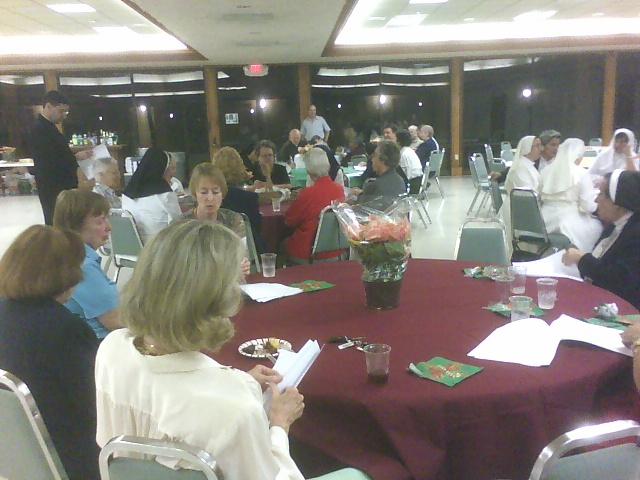

2 tests – Archangel Battle – tables
MODERN PHILOSOPHY – (Fr Santos) — Quiz on Decartes. 3 essay questions took the whole hour: How was he successful at determining “self” as the “rock of certainty”? How did he fail at proving “world” and “God” as “innate”? How was “world” distinct from “self” and “God”? — at least those are the questions I thought (through subjective perception and err) I answered.
ANCIENT PHILOSOPHY – (Fr Santos) — continued Plato’s Phaedo to explore personal, social & objective immortality. Body vs soul. 4 Causes: material, efficient, formal & final.
ARTS & IDEAS – (Fr Vallee) — test on Classic Greek Culture. Also turned in a 3 page Reflection paper on “Greek Hellenic Idealism vs. Hellenistic Reality.”
SOCCER TOURNAMENT — Soccer has become some big here that we have a 4 team tournament going on. Today was game 2 of round 1. It was called the “Battle of the Archangels” because one team is called St Raphael and the other ??? Today’s game was supposed to be last night, but there wasn’t enough light. — today was too hot (1:30pm)

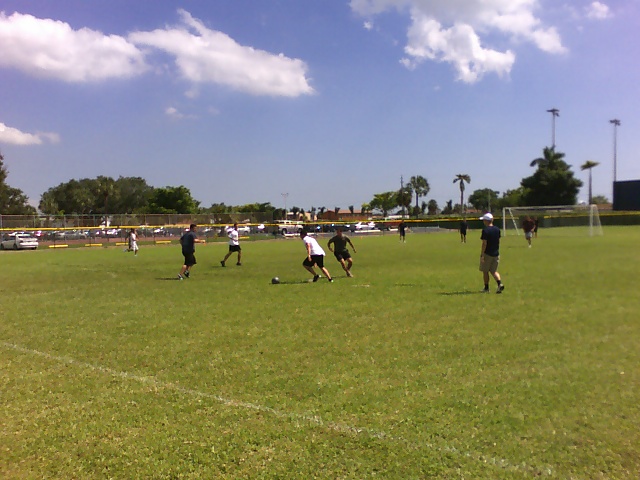

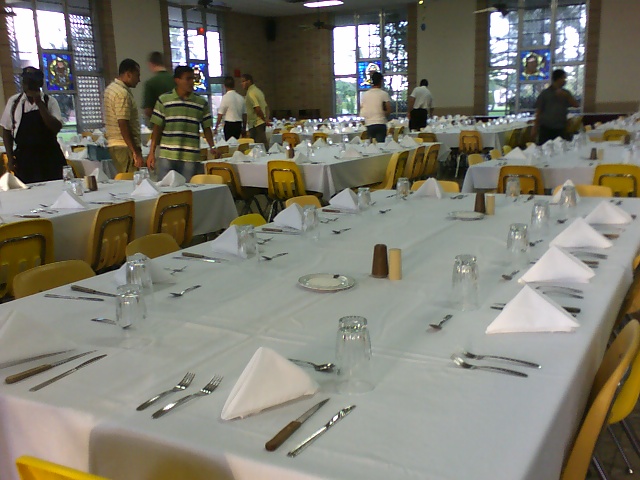 TABLE SETUP — in preparation for Parent Day tomorrow, we set up the tables in the Refrectory for 300 people! — wow
VOCATION LINK UPDATE — Yesterday I had a record 35 hits on my Vocations link page (& 190 for my whole site), so I decided to add more than just Miami links. Added some links for general vocation info, seminary listings and all the diocese of Florida with their vocation links. I even found some profiles of some of my brother here. — it only took me 4 month to add stuff in a half hour … procrastinator
new men commit – steak & champaign
SPANISH 2 – (Dr Jimenez) — today we continued the imperative verb forms like “ataca Anti-Christo” and revisited the “gang of irregular preterites” (–ataca them too)
MASS – (Fr Michael) — today’s schedule was changed with 4:30 Mass for the “New Men Commitment & Reception Ceremony” to officially accept the New Men into the house, marking the end of the “New Student Experience.” The homily highlighted the feast of the Korean martyrs Andrew (priest) and Paul (catechist & seminarian). A beautiful Mass with a steak & champaign dinner afterwards. —delicious
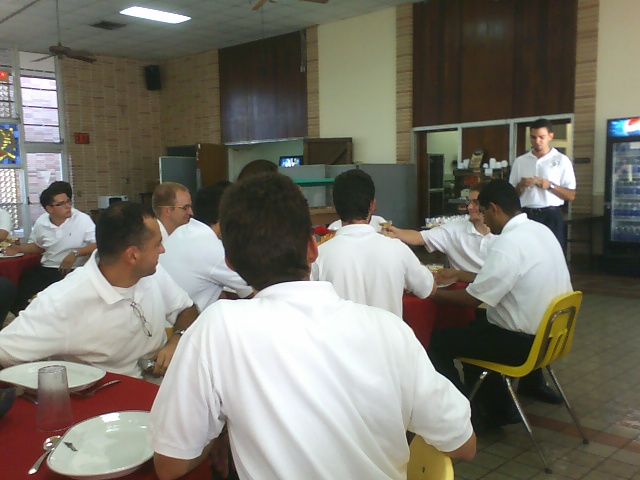


RECTOR’s CONFERENCE – (Fr Michael) — the “New Men” had part 2 of 2 on “The Priesthood: A Theological Overview.” — Busy day.
words by THE WORD
MASS – (Fr Michael) — we can only preach Christ on our lips if THE WORD (Christ) is in our hearts. [Eucharistic minister were also commissioned – seniors & pre-Theology 2]
DAY — Spanish 2 preterite quiz. Also watched “300” again, all the way through. In the evening, the “New Men” had a Rector’s Conference on “The Priesthood: A Biblical Overview” (part 1 of 2) with small group discussion afterwards.
Catholic military chaplains
 I finally received a packet from the Vocation’s Director of the Archdiocese for Military Services (AMS). It contained a couple brochures specific to Catholic chaplains, but mostly brochures from the Army, Air Force & Navy. I asked for the Marines, but I guess they’re considered part of the Navy. Anyways, there’s some interesting figures: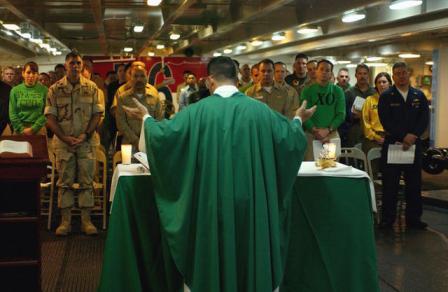
-
The AMS serves 375,000 Catholic soldiers — 520,000 family members — 204,000 in Reserves & National Guard — 29,000 Catholic patients in 172 Medical Centers — & 66,000 Catholics in government service overseas (in 134 countries).
-
Geographically, the AMS is the largest in the Church, trans-national without borders at 220 installations in 29 countries.
- To meet all those needs, they have fewer than 350 full-time Catholic military chaplains with the Army, Navy, Air Force, Marines & Coast Guard.
- They have 480 priests serving part-time with Reserve forces & National Guard.
- The priests serving full-time are on loan from 142 dioceses and 44 religious communities.
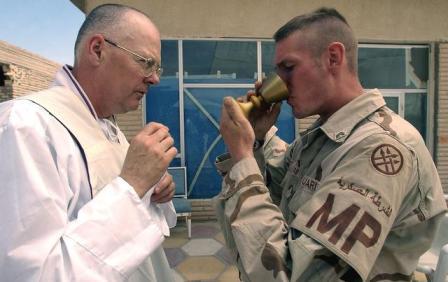 As excited I am about the military, I also realize the needs and dynamics of serving soldiers can be extremely diferent from Miami pastoral ministry. I’d like to stay open to the possibility of a summer internship (in a theology year), but I don’t currently feel drawn into any permanent call. — I need to slow down and focus on the now.
SJV pre-Theology program
The website for St. John Vianney College Seminary has a new look. It loads kind of slow, but looks pretty cool. I got excited when I saw the “tour of the chapel” because I thought it would give a detailed explanation of the mural above the altar (like they did at “Vocation Awareness Weekend”), but all it has is 3 close up pics of the front. — still better than the old sight.
Nevertheless, I finally know my courses for the 2-year Pre-Theology program (below) that I’m in. They also have the details of the Collegiate (4-year) program, news & a calendar for next year. — looks good.

Miami seminary – part 2
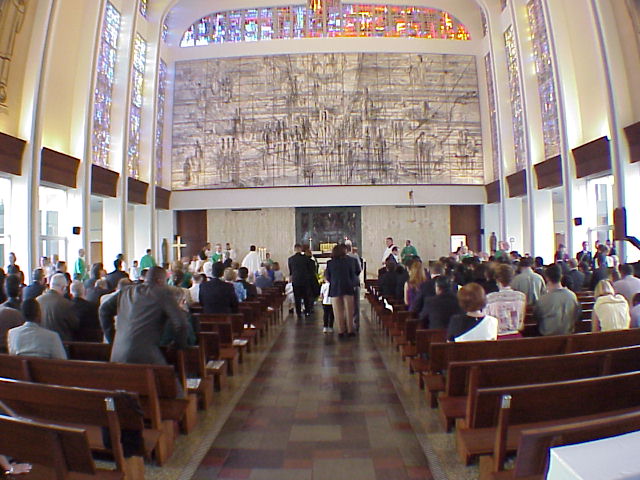 After my last post, I got a response from a former student at St. John Vianney Seminary High School in the 1970’s. He hosts a website to track former students and faculty to see where they are now. He has some great historical info and pictures about the campus. Apparently, the school used to teach young men in 9-12 grade from 1959 to 1975. It has some great pictures of St. Raphael Chapel (pictured here) from the 40th Anniversary in 1999. —nice.
Miami seminary
 I was looking on the Archdiocese of Miami website for a video of catholic military chaplains that is no longer on their video page (–I downloaded it last year). There is, however, a great little video about St. John Vianney Seminary in Miami (which I’m starting next month) called “A Call to Faith” (DSL or dialup).
 While I continued searching the website, I found a great article from last year called, “The people of God deserve the best.” It’s an interview with Father Michael Carruthers, the new rector of St. John Vianney Seminary. He spoke about the quality and “wholesomeness” of the young men who are entering the seminary today. I found a profile on him as well as 24 other priests on another page called “Building the City of God.” Besides hearing some great homilies last November @ the “Seminary Vocation Weekend,” I personally met with Father Carruthers (as part of the application process) and was very impressed by his sincerity, encouragement and attentive ear. — he’s definitely someone I look forward to grow with.
military priests
Reading and writing about military chaplains over the past couple of days awoke my passion for the military. I wrote an email to the Archdiocese of Military Services, and got a response from Auxiliary Bishop Estabrook. The Archdiocese of Military Services doesn’t take priests directly but rather accepts priests “on loan” from individual dioceses for a period of three years and up. They don’t have a seminary or incardinate priests. All their priests must have been priests and had a pastoral assignment for at least three years before coming on active duty.Each Service has a seminary program. When accepted by that Service and with permission of your diocese, you could be commissioned a reserve officer while in theology and have a chance to serve at an installation sometime during your studies just to see what the chaplaincy is like.
Father Chandler, the Vocations Director, will be sending me materials and be in touch. — I’ll see what happens.
Happy is God’s Will?
Continuing the discussion on “following God & seeking His Will” from last Sunday’s readings, I recall an experience. — Last year I was at a men’s study group where everyone was asked “How do you know you are following God’s will in your life?” After we spend some time getting everyone’s opinion (I forgot what I said), the facilitator (a priest) answered simply “When you’re happy.”
 WHAT?!?! I hate that answer! (In his defense, we were running out of time and I think he was moving the meeting along) Happiness is relative and can be found in anything. Even doing something bad or sinful can have temporary (or fake longterm) happiness … that’s WHY we do bad things … it fills the “God-size” void we have.
Happiness is a feeling we get … and you can’t always trust feelings. “Joy,” on the other hand, is different. We get “joy” by knowing we have salvation through an active relationship with God. You can always be joyful even though circumstances may make us miserable and very UNhappy.
If a believer is being persecuted for their faith, are they following God’s will? Even though they’re not “happy” at the moment? Do we fast to be “happy”? I hope I misunderstood the answer, because I need some clarification. — Anyone else? Kermit?
“holiness” in Rise … by John Paul II
 With a bad rainstorm (drought-relief) today, I started re-reading John Paul II‘s book, “Rise, Let Us be on Our Way.” Although it mainly reflects on his journey to and through becoming a bishop, it is written for everyone. It’s a simple read with great personal insight and advice for all Christians. Here are some points I highlighted from the Ordination Liturgy parts of “Vocation” (section 1):
At a priestly ordination, the hands area anointed; at an episcopal [bishop] ordination the head is anointed. This signifies the call to new responsibilities: the bishop will have the task of guiding the Church, which will palce great demands on him. … The ring on the bishop’s finger signifies that he is married to the Church, the sign of fidelity … to protect the holy Church, bride of Christ. … The Book of Gospels is given to remind of a bishop’s calling, to not only serve, but he must be a teacher. … The miter is a reminder of his commitment to let the “light of holiness shine in him” like a “city on a hill” (Mt 5:14) to be “a living example to the flock” (1 Pet 5:3). … The crosier is a sign of the authority that enables the bishop to fulfill his duty to care for his flock.
Outside of the cool symbols, what really struck me was the personal call to holiness that ALL need to find.
The essential meaning of holiness is that it is always personal, and that each and every man is called to it. All members of the people of God are called, but each is called in a unique and unrepeatable manner. … A shepherd must watch, protect and lead every sheep to discover that holiness is not “some kind of extraordinary existence, possible only for a few ‘uncommon heroes’ of holiness. The ways of holiness are many, according to the vocation of each individual.” What a great potential of grace lies dormant in the vast numbers of the baptized!
— I can say no more.
“follow me” & trust
 Today’s readings spoke directly to me. In the first reading (1 Kgs 19:16b, 19-21), Elijah (directed by the Lord) called Elisha to follow and succeed him as a prophet to the people. Elisha recognized God’s call and left his life, sacrificed (literally), and did God’s will wholeheartedly, knowing a prophet’s life is miserable (but the retirement benefits are out of this world).
Then, in the Gospel reading (Lk 9:51-62), some disciples tell Jesus, “I will follow you wherever you go.” (–easier said than done) When some start to hesitate, Jesus reminds them, “… go and proclaim the kingdom of God.” They declare they’re willing, but don’t give up their old lives to respond to the call. Jesus sums up with “No one who sets a hand to the plow and looks to what was left behind is fit for the kingdom of God.”
I need some clarification here! The basic message seems to be the first commandment, “trust God wholeheartedly without reservations.” But the fine print seems blurry. How “blindly” are we to follow “God’s will.” It seems to be a extremist’s motto. It’s demanding, unquestionable and instantaneous. Where’s the discernment process?
As we discern God’s will for the “big” things in our lives, like choosing a vocation to the priesthood, religious life, marriage or the single life, hearing the call is difficult. I guess that’s why discernment takes so long. But how do you know when you have an answer or final decision that has God’s hologram stamp? I’ve heard that some who become priests still have doubts, even after a 6-9 year discernment process. Some closure would be the least you could get for a lifelong commitment. — Is it just me?
Church history, #2 Paul the Troubleshooter
 As I revist the book, The Story of the Church: Peak Moments from Pentecost to the Year 2000, chapter 2 is “First-Century Adjustments,” focusing on Paul the Apostle. It has always confused me how Paul was the “go-to-guy” to answer any questions of theology & the Christian life. He wasn’t even one of the original 12 apostles, but spoke with such authority, even declaring himself an apostle. His conversion story (Acts 9) is amazing enough. But even more unbelievable is how fast the Christian community embraced him and bestowed authority to dictate Christian “policy,” an even greater testament to grace and the submission to the Holy Spirit.
Paul is a master cameleon of evangelization, able to adapt the gospel message to any culture. He was well-versed in the Hebrew Scriptures (OT), had a heart for his audience, walked in their shoes, and presented the challenge of the Gospel in their “language.” — everything a Christian is called to do. A great example is Paul’s sermon to the Athenians in Acts 17:16-34. It seems so supernatural … because it is … it’s only possible through the Holy Spirit.
That reminds me of a line from the “Fishers of Men” priesthood video when it’s said, “It’s not natural to be a priest … it’s a supernatural calling.” — You can’t disagree with that.
Exorcism outs the Devil
 One of the greatest “gifts” God gave to the Church was the power of exorcism. What most people think about when you say exorcism is actually a “major exorcism” where the Church determines a demon has possessed someone’s body (but not taking their free will) and a priest (approved by the bishop) does the rite of exorcism (usually done in 5 minutes, but may take several months). I didn’t explore my ignorance about exorcism (because I thought it may invite bad stuff) until I saw a DVD available called “Interview with an Exorcist”.
Here’s a few facts that clarified my misconceptions. Although a demon may possess a body, it does not control a person’s free will. All priest are taught the rite, but the bishop must approve doing one. A priest prepares more for the the sacrament of reconciliation than the rite of exorcism. Priests have been known to successfully perform exorcisms in the state of mortal sin (it’s not a battle between the priest & a demon, it’s between GOD & the demon). Any prayer denouncing the power of Satan is a prayer of exorcism. Although a majority of possessions includes some occult practices, even a Christian believer can be possessed (although less likely).
I think I was more afraid of exorcism due to my own ignorance than I am today. I would recommend more knowledge & understanding to those who may empathize. A new book supplements the DVD just came out. More Catholic resources on exorcism are HERE. The movie The Exorcism of Emily Rose is also pretty good.
I saw an episode of Showtime’s Penn & Teller’s Bullsh*t about exorcism (season 5#5). They had some ridiculous (non-Catholic) “exorcists” that made the whole rite into a joke, concluding there is no such thing as demonic possession. They just affirm Verbal Kint (Kevin Spacey), “The greatest trick the devil ever pulled was convincing the world he did not exist.”
This is WHY exorcism is a “gift.” In an exorcism, Satan is manifested (revealing his existence) and the supreme power of God over evil glorifies our Lord. — but I don’t want to be the person in the middle (possessee).
Priesthood = Marriage
 Today was the installation Mass for Fr Pedro Corces as pastor at St. Katharine Drexel in Weston. As the former Vocations Director for the past 10 years, it was nice to see Bishop Noonan with several other priests & seminarians, many of whom he pastored to the priesthood. Fr Pedro was also one of the 3 vocation board members that interviewed me. In the short time I spoke to him, I can see what I great pastor he will be with his sincerity, insight and compassion. During the bishop’s sermon, I was struck by how the marriage vows were used to show the relationship between pastor and parish family:
Do you [Pastor] take [the church] to be your Bride [of Christ]? Do you promise to be true to Her in good times and in bad, in sickness and in health? Will you love and honor Her all the days of your life? Is this your solemn vow?
And the parish responses as the “Bride”. What a beautiful picture of the priesthood. Just as in a marriage, self-sacrificing to care for each other. In Ephesians 5:23-28,
23 For the husband is head of his wife just as Christ is head of the church, he himself the savior of the body. 24 As the church is subordinate to Christ, so wives should be subordinate to their husbands in everything. 25 Husbands, love your wives, even as Christ loved the church and handed himself over for her 26 to sanctify her, cleansing her by the bath of water with the word, 27 that he might present to himself the church in splendor, without spot or wrinkle or any such thing, that she might be holy and without blemish. 28 So (also) husbands should love their wives as their own bodies. He who loves his wife loves himself. (NAB)
A priest sacrifices his own bride & family to care for and sanctify the church as the “Bride of Christ.” It makes sense to me.
I should “do as I say”
After reading my blog from yesterday about presenting ALL vocations in order to encourage the priesthood, I smiled. I realized I should lead by example. This blog may encourage someone to consider the priesthood, but what about the other vocations? Maybe I could have a forum section (which I could do with Community Server 2.1) for each of the vocations. Anyone would be able to post questions and answers about any vocation. A blog is more “I talk, you listen” while a forum encourages more community response and communication. I’ll look into it. — Kermit? Anyone?
Present “ALL” Vocations
 The best way that I think we can encourage vocations is by presenting “ALL” the vocations. In an audio talk by Scott Hahn called, “Vocations in Scripture: Discovering & Discerning God’s Call,” (#5627-CD) he does just that. He begins his talk by saying we all have the same inherit primary vocation, and that’s to be a “child of God the Father” by accepting Jesus and living active christian lives. Besides that, we can live out our faith through the vocations of single life, married life, religious life, or the priesthood. He then details each one as seen through Scripture. I think that is how we should encourage vocations. We need to present ALL of them as equally necessary, yet individually unique. I think that approach would make people more open to priesthood and the religious life, because I wouldn’t be seen as so far removed from each of us. — Kermit? Anyone?
TV show idea: new “Big Brother”
Marketing is super important to vocations. That’s why I started this blog in the first place (even though it goes against by personality — a friend noted). As we encourage vocations and make them more “transparent” to everyone, we risk exposing ourselves. If we have to make ourselves more vulnerable to scrutiny from others, than that’s a risk we must take (isn’t that what we’re called to do anyways?). The marketing needs to be done by the whole church, but begin with the clergy, religious and seminarians (the newbies).
 We need better marketing! Take more pictures and videos, make more relevant websites and blogs, present the “reality.” The cable special “God or the Girl” was a good start, but what about a reality show like “Big (Seminarian) Brother (or Sister).” I think lots of people would watch that, especially non-believers. Even if you have some bad examples on the show, it would just be an opportunity to evaluate, grow and demonstrate our humanity. — Am I the only one who sees this? Kermit? Anyone?

SJVCS Seminary Life Album

July '09 -- hospital chaplains @ IPF
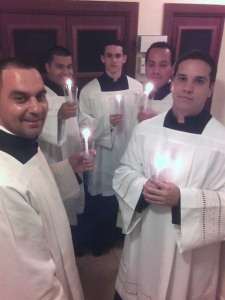
Easter '09 -- Miami SJVCS friends

the Son always finds a break in let the clouds

Feb '09 -- school vocation talks @ AMHS

Feb '09 -- cold breakfast with brothers (Matias, Fenly & Randy), now at SVDP and Imad (at SJVCS)

Superbowl '09 -- eating great @ SJVCS

Sept '08 -- Worklist Coordinators?

St Raphael Chapel mural @ SJVCS

Sept '08 -- retreats @ SJVCS

"It's not easy being green"
 Catholic Kermit

Recent Comments